Key Facts
- Railroad challenges helped advance material standards, nondestructive testing, and network optimization.
- Railroads were using technologies like computer simulation and ultrasonic inspection decades before they became commonplace.
- Innovations developed for rail now help run supply chains and inspect critical infrastructure across industries.
🎧 Listen to this page • 10 min 31 sec
Adapted for listening and narrated by a real person. Read the full narration at the bottom of this page.
Since 1827, freight railroads have been rolling laboratories for innovation. Faced with challenges no one had solved before, they developed new technologies, systems, and ideas to move people and goods more safely, efficiently, and reliably. Many of those breakthroughs reached far beyond the railroad, helping shape everything from barcodes and package tracking to product safety. Here are some of the surprising innovations that started on the rails—and changed much more than railroading.
Modern barcodes come from a freight rail challenge.
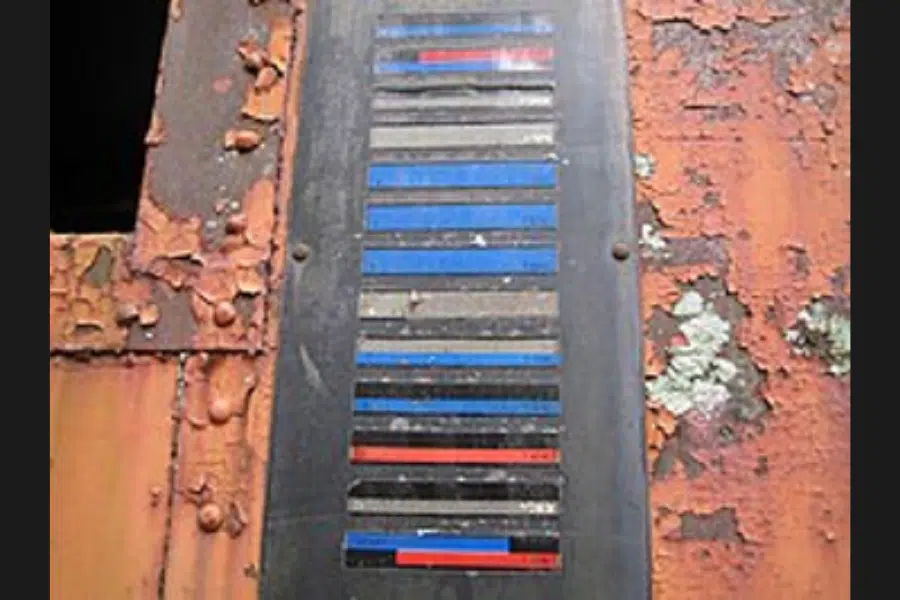
In this image, the tag reads: START 8350199918 STOP 5.
Long before barcodes appeared at store checkouts, freight railroads were trying to solve the same problem: How do you automatically identify huge numbers of moving objects?
In the 1960s, railroads began testing KarTrak, a colored barcode system designed to identify freight cars as they moved across the national rail network. The system was designed by David Collins, an MIT graduate who had become aware of the need for tracking rail cars while working for the Pennsylvania Railroad as an undergraduate.
KarTrak tags used a vertical stack of 13 colored labels, each acting like a data line. Together, the labels encoded digits 0–9, a checksum value, and START/STOP markers that told scanners where the tag began and ended. By the mid-1970s, some 90% of U.S. rail cars carried KarTrak labels.
The idea was ahead of its time, but dirt, weather, and wear made the labels difficult to read, and the system was eventually abandoned. Railroads later replaced KarTrak with RFID-based Automatic Equipment Identification (AEI) tags—small electronic “digital nameplates” that trackside readers can identify automatically as trains pass by.
KarTrak didn’t survive, but it proved that physical objects could carry machine-readable identities and be tracked automatically at scale. That same idea became the foundation for the widespread use of retail barcodes, warehouse logistics, and modern inventory systems.
Train tickets helped inspire the technology that led to IBM.
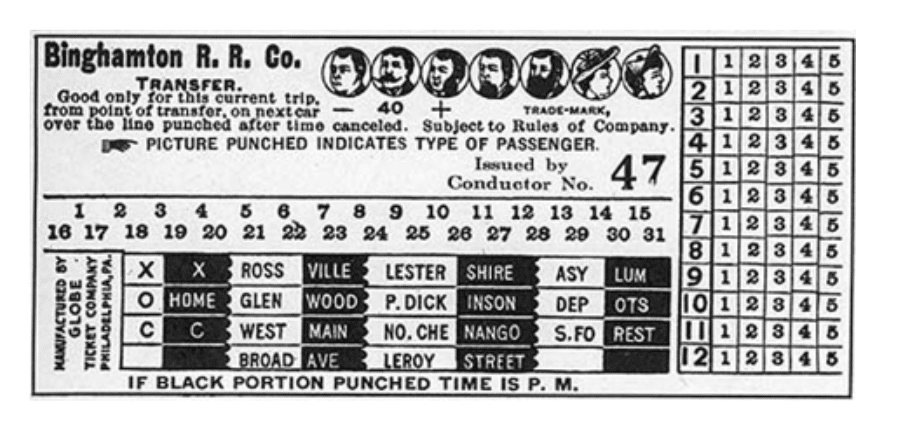
A railroad “punched photograph” ticket, circa the 1880s.
In the 1880s, the U.S. Census took years to count by hand. Engineer Herman Hollerith, who worked for the Census Office, found inspiration in an unlikely place: a railroad ticket.
Railroads were trying to stop passengers from sharing or reselling tickets, so conductors used something called a “punched photograph.” Instead of attaching a photo, they punched out preprinted words along the edge of a ticket—such as male or female, young or elderly, light or dark eyes, mustache or none—leaving behind a coded physical description of the traveler. Hollerith later recalled that the idea stuck with him after a train trip. If a pattern of holes could describe a passenger, why couldn’t it describe data?
He applied the concept to the census, creating punched cards in which each hole represented a fact like age, occupation, or location. Machines could sort and count those cards far faster than people could process paper records by hand. His system dramatically accelerated the 1890 U.S. Census and ultimately laid the foundation for the punched-card industry and the company that would become IBM.
Freight rail helped change how companies share innovations.
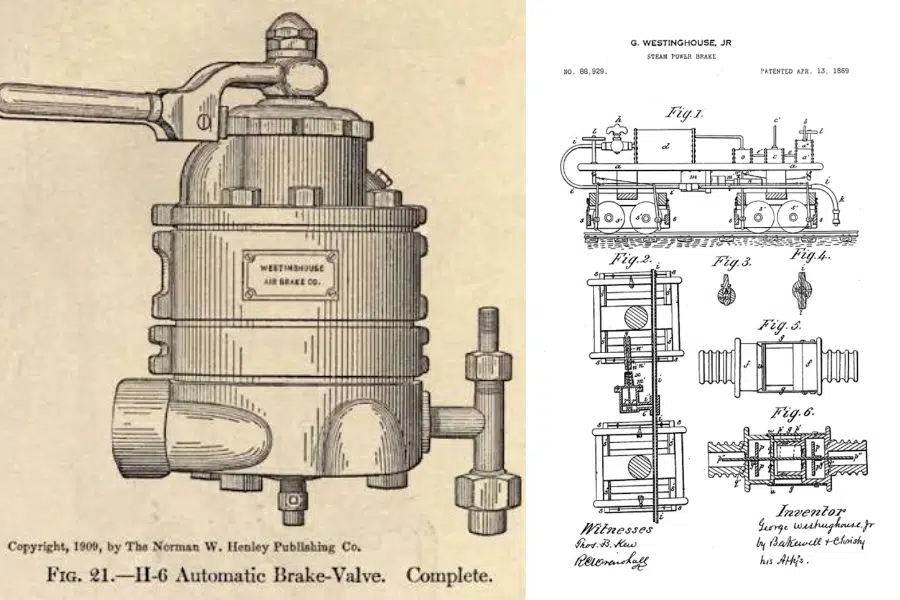
George Westinghouse’s 1869 patent for the automatic air brake.
In the late 1800s, railroads were going all in on adopting new technologies. Better brakes, stronger steel, safer couplers, and improved signaling systems were invented quickly. But there was a problem.
Many of those innovations were protected by patents owned by different inventors and manufacturers. A single railroad could need dozens of patented technologies to build or operate a train. This challenge led to lawsuits, competing designs, and equipment that didn’t always work together.
To keep innovation moving, railroads encouraged manufacturers and inventors to cross-license patents, form patent pools, and agree on shared technical standards. Instead of fighting over every invention, companies increasingly found ways to share essential technologies so the entire rail network could benefit.
Today, that same approach to locking down innovations is used across industries. Everything from Wi-Fi and smartphones to video streaming and electric vehicles depends on companies licensing key patents to one another so products from different manufacturers work together.
Railroads helped make the stuff we buy safer.

Dr. Charles Benjamin Dudley (1842-1909).
In the late 19th century, broken rails were a real danger. As trains grew heavier and more frequent, weak or inconsistent steel could crack under pressure, causing derailments, damaging cargo, and putting passengers and crews at risk. The issue was that rail quality varied wildly. One steel rail might wear out or fail after only months in service, while another could last for years.
To figure out why, the Pennsylvania Railroad hired chemist Charles B. Dudley to study rails like evidence — looking at their chemical makeup, physical strength, hardness, wear, and performance in the field. Dudley’s work helped shift the question from “Who sold us a bad rail?” to “What standards should every rail meet before it ever goes into the track?” That was a big leap: instead of trusting a supplier’s word, railroads began demanding consistent tests, measurable specifications, and proof that materials could hold up under real-world stress.
That push for consistent, science-based testing helped lead to ASTM International, founded in 1898. Today, ASTM standards touch thousands of things people rely on every day — from playground equipment and bike helmets to building materials, electronics, medical devices, and household products.
Railroads helped create nondestructive testing.
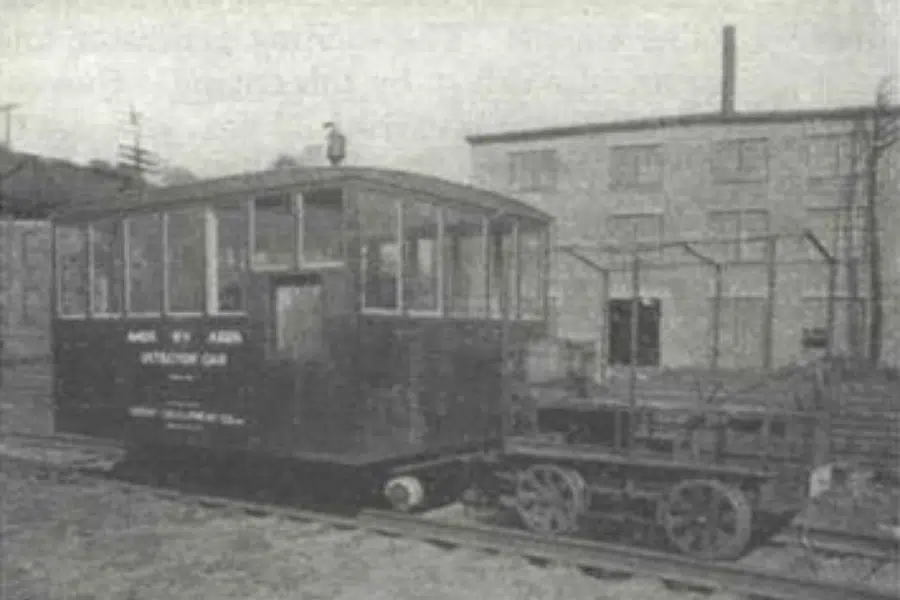
Elmer Sperry’s SRS 102, the world’s first commercial rail detector car, introduced in November 1928 to scan for hidden internal track defects using induction.
Dudley first asked, Is this steel good enough? A few decades later, the railroad industry brought inventor Elmer Sperry a different problem: How do you find something going wrong inside the steel? In the 1920s, rails could look perfectly normal while hiding internal cracks that could eventually cause them to break. Railroads needed a way to find those defects without cutting into the rail and destroying it.
The American Railway Association (the direct predecessor to The Association of American Railroads) turned to Sperry to find a solution. His team first experimented with magnetic detection, building a hand-pushed device that magnetized the rail and looked for disturbances caused by hidden flaws. But dirt, rust, and other conditions made the early approach unreliable.
Sperry kept working. He developed a new system that sent electrical current through the rail and used induction coils to detect changes in the resulting magnetic field. A hidden crack disrupted that field, revealing a problem inside seemingly solid steel.
The railroad industry then helped scale the idea. Beginning in 1926, the American Railway Association and Sperry jointly financed development of a rail detector car that could carry the technology over miles of track. A successful car was delivered in 1928.
The technology advanced again in 1949, when Sperry introduced ultrasonic rail testing. High-frequency sound waves traveled through the steel and revealed hidden flaws—essentially a medical ultrasound for steel. Today, Automated Track Inspection (ATI) builds on that idea with specialized vehicles and train-mounted systems that use ultrasound, lasers, cameras, and sensors to spot defects and target maintenance before problems become safety risks.
That same principle now extends far beyond railroads, helping inspect aircraft, pipelines, bridges, power plants, and other critical infrastructure for hidden problems without damaging what is being tested.
Freight rail waybills influenced modern “buy now” shopping.

A vintage freight waybill from the Coudersport and Port Allegany Railroad Co., documenting a 1950s shipment of personal effects from Pennsylvania.
Long before anyone opened an app to see where a shipment was, railroads had to answer the same basic questions at national scale: What is this car carrying? Where did it start? Where is it going? Who owns the car? Who gets paid? And which railroads handled it along the way? That information lived in waybills and car records — the paperwork that told a shipment’s story.
A single load could move across several railroads before reaching its destination, so the records had to travel with the freight, hand off cleanly from one carrier to the next, and make sure the right companies were paid. In practice, railroads were building one of America’s first large-scale business information systems: standardized records, routing codes, ownership details, shipment instructions, accounting rules, and operating reports that helped thousands of moving pieces stay connected.
Modern logistics software works on the same basic principle. Every shipment needs an identity, a destination, a chain of custody, and a history — whether it is a railcar full of grain or a package on your doorstep.
Freight rail helped develop modern farming.

1910 photo showing the interior of a “corn train” with instructor Ralph Bliss.
In the early 1900s, farming was changing fast. Universities and research labs were developing better ideas about soil, seeds, livestock, and pest control — the kind of practical science that could help farmers grow more food, reduce losses, and reach bigger markets.
The challenge was getting that knowledge to the people who needed it most. Many farmers lived far from universities or government experts, and railroads had a practical reason to help: more productive farms meant more grain, fruit, livestock, fertilizer, machinery, and food products moving by rail.
So, railroads partnered with land-grant colleges, state agriculture agencies, and the U.S. Department of Agriculture to bring farm science directly to rural communities by train.
These “demonstration trains” were rolling classrooms: part exhibit hall, part lecture tour, and part lab. They carried professors, scientists, machinery, seed samples, livestock, and hands-on displays from town to town, showing farmers how to improve soil, grow better crops, raise healthier animals, and fight pests or disease.
Freight rail helped pioneer modern simulator training.
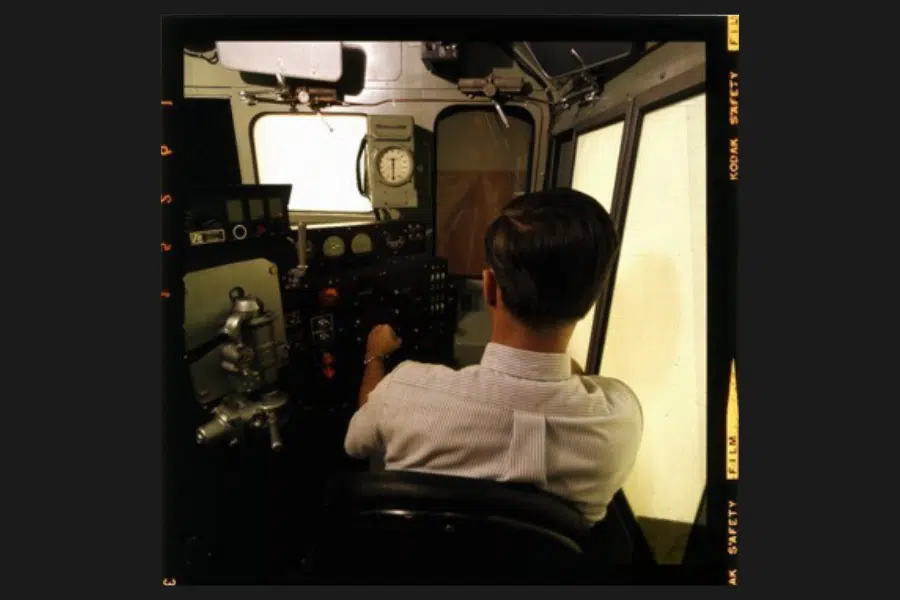
A slide of an ATSF locomotive simulator, August 1969.
Rail safety has always advanced one breakthrough at a time. Better brakes. Stronger signals. Smarter training tools. Decade after decade, freight railroads adopted new technology to reduce risk before the next big safety challenge arrived.
In the 1960s, The Santa Fe Railway built one of the country’s first full-scale locomotive simulators. Engineers sat inside a real locomotive cab with working controls while a giant projection screen displayed motion-picture film shot from the front of actual trains traveling real routes.
But it wasn’t just a movie. The film projector was connected to a computer. Open the throttle and the film sped up. Apply the brakes and it slowed down. The computer even projected different signal colors onto the filmed landscape, allowing instructors to create new scenarios every time an engineer trained. The simulator also recreated locomotive movement, vibration, and braking using motion technology adapted from military and airline flight simulators.
Read the AAR Audio Narration
The Surprising Innovations That Started on the Rails
This is AAR Audio, and you’re listening to The Surprising Innovations That Came from Freight Railroads.
Trains aren’t just trains. They’re kind of like rolling laboratories for innovation.
For hundreds of years, railroads have had to solve problems most industries had never faced before.
How do you track thousands of moving railcars?
How do you find a crack hidden inside solid steel?
How do you train someone to operate a massive locomotive before putting them out in the real world?
Solving problems like these pushed railroads to invent new technologies, establish new standards, and develop entirely new ways of doing things.
And the surprising thing is, a lot of those ideas didn’t stay on the railroad.
They helped shape technologies and systems we still use every day.
Take the barcode.
Long before anyone was scanning a box of cereal at the grocery store, railroads needed a way to automatically identify freight cars moving across a national network.
In the 1960s, they began testing a system called KarTrak.
Each railcar carried a stack of brightly colored stripes. Trackside scanners read those stripes as the car passed and identified exactly which railcar it was.
By the mid-1970s, roughly 90% of U.S. railcars had these KarTrak stripes.
But the system itself ultimately had a problem.
Railroads are dirty.
Mud, weather, and wear and tear made the colored labels difficult to read reliably.
The system was eventually replaced by electronic tags.
But the basic idea was right.
Give a physical object a machine-readable identity and automatically track it as it moves.
That same concept became fundamental to retail barcodes, warehouses, inventory systems, and modern logistics.
Railroads influenced computing in another surprising way.
Back in the 1880s, the U.S. Census was trying to process an unbelievable amount of information by hand.
Engineer Herman Hollerith found inspiration in something railroad conductors were already doing with passenger tickets.
To prevent people from sharing or reselling tickets, conductors punched holes into the sections of the ticket that described the passenger.
Age.
Gender.
Eye color.
Even whether someone had a mustache.
Hollerith realized those holes could represent other kinds of information too.
So he developed punched cards that encoded census data. Machines could then sort and count the information far faster than people could.
The technology dramatically accelerated the 1890 Census.
And Hollerith’s work eventually helped lay the foundation for the company that became IBM.
Now, railroads didn’t just help change technology.
They helped change how industries share technology.
By the late 1800s, new railroad inventions were arriving quickly.
Better brakes.
Safer couplers.
Stronger steel.
Improved signals.
But many were protected by different patents.
That created a problem on a national network where everything had to work together.
So railroads helped encourage patent licensing, patent pools, and common technical standards.
Instead of every company building incompatible systems, essential technologies could be shared and standardized across the network.
That basic approach is everywhere today.
Wi-Fi.
Smartphones.
Video streaming.
Electric vehicles.
Different companies can build different products because they agree to share certain technologies and follow common standards.
Railroads also helped change how we know whether the things we buy are actually safe.
In the late 1800s, steel rails could vary dramatically in quality.
One might last for years.
Another might fail after only a few months.
So, the Pennsylvania Railroad brought in chemist Charles Dudley to figure out why.
Dudley studied the steel itself.
Its chemistry.
Its strength.
Its hardness.
And how it performed under real railroad conditions.
His work helped change the conversation.
Instead of asking who sold a bad rail, the industry began asking what every rail should be required to prove before it goes into service?
That meant measurable specifications.
Consistent testing.
And standards based on science.
That movement helped lead to the creation of ASTM International in 1898.
Today, ASTM standards apply to thousands of products and materials.
Playground equipment.
Bike helmets.
Electronics.
Medical devices.
Building materials.
The idea that products should meet consistent, measurable safety standards?
Railroads helped push it forward.
But Dudley’s work raised another question.
What if the problem isn’t something you can actually see?
By the 1920s, railroads knew that a steel rail could look perfectly normal on the outside while hiding a dangerous crack inside.
The industry turned to inventor Elmer Sperry for a solution.
His team experimented with ways to detect those hidden flaws without cutting into the rail.
Early attempts used magnetism.
Then Sperry developed a system that sent electrical current through the rail and detected changes in the resulting magnetic field.
A hidden crack disturbed that field.
Now inspectors could essentially see inside solid steel without destroying it.
The railroad industry helped turn that idea into something practical.
Beginning in 1926, the American Railway Association and Sperry jointly financed development of a rail detector car that could inspect miles of track.
By 1928, it was working.
Then came another leap.
In 1949, Sperry introduced ultrasonic testing.
High-frequency sound waves traveled through the steel and revealed hidden defects.
Think of it like an ultrasound for railroad track.
That basic principle eventually spread far beyond rail.
Nondestructive testing now helps inspect aircraft, pipelines, bridges, power plants, and other critical infrastructure without damaging the thing being inspected.
Even the way we track a package today has roots in a problem railroads had to solve generations ago.
A railcar might travel across several different railroads before reaching its destination.
Everyone along the way needed to know what was inside.
Where it came from.
Where it was going.
Who owned the car.
And who needed to get paid.
Railroads managed all of that through waybills and car records.
Essentially, every shipment had an identity and a history that traveled with it.
Those records had to work across different companies and different parts of the country.
Sound familiar?
Modern logistics software follows the same basic idea.
Every shipment needs an identity.
A destination.
A chain of custody.
And a history.
Whether it’s a railcar full of grain or the package sitting on your doorstep.
Railroads even helped bring new technology directly to America’s farmers.
In the early 1900s, agricultural science was advancing quickly.
Researchers were learning more about soil.
Seeds.
Livestock.
Pests.
And how to grow more food with fewer losses.
The problem was getting that information to farmers living hundreds of miles from universities and research centers.
So railroads helped bring the classroom to them.
Working with universities, agriculture agencies, and the federal government, they operated demonstration trains that traveled through rural communities.
These were essentially rolling classrooms.
Scientists and professors traveled onboard with machinery, seed samples, livestock, and hands-on exhibits.
Farmers could walk through the train and learn about the latest agricultural techniques right in their own communities.
Railroads weren’t simply moving the products of American agriculture.
They were helping spread the knowledge that made American agriculture more productive.
And decades before today’s virtual training systems, railroads were experimenting with simulation.
In the 1960s, the Santa Fe Railway developed one of the country’s first full-scale locomotive simulators.
Engineers trained inside an actual locomotive cab.
In front of them, a giant screen played film recorded from real railroad routes.
But this wasn’t just like watching a movie.
The simulator reacted to what the engineer did.
Open the throttle…
The film sped up.
Apply the brakes…
It slowed down.
A computer could even change the signals displayed on the filmed route so instructors could create different scenarios.
The system recreated movement and vibration too, using technology adapted from military and airline flight simulators.
Engineers could practice responding to real-world situations without putting a real train—or anyone around it—at risk.
Barcodes.
Computer data processing.
Shared technology standards.
Product testing.
Nondestructive inspection.
Shipment tracking.
Agricultural education.
Simulation training.
They may seem completely unrelated.
But they all share part of the same story.
Since North American freight rail began in 1827, railroads have faced challenges that required new solutions at enormous scale.
Sometimes the solution transformed railroading.
Sometimes it traveled much further.
And sometimes an idea developed to solve a problem on the rails quietly became part of everyday American life.
The Bottom Line
Freight railroads helped invent the systems that make modern life work, from barcodes and product safety standards to logistics software, infrastructure testing, farming outreach, and simulator training.