KEY FACTS
- 2025 was a record-breaking year for safety for the rail industry.
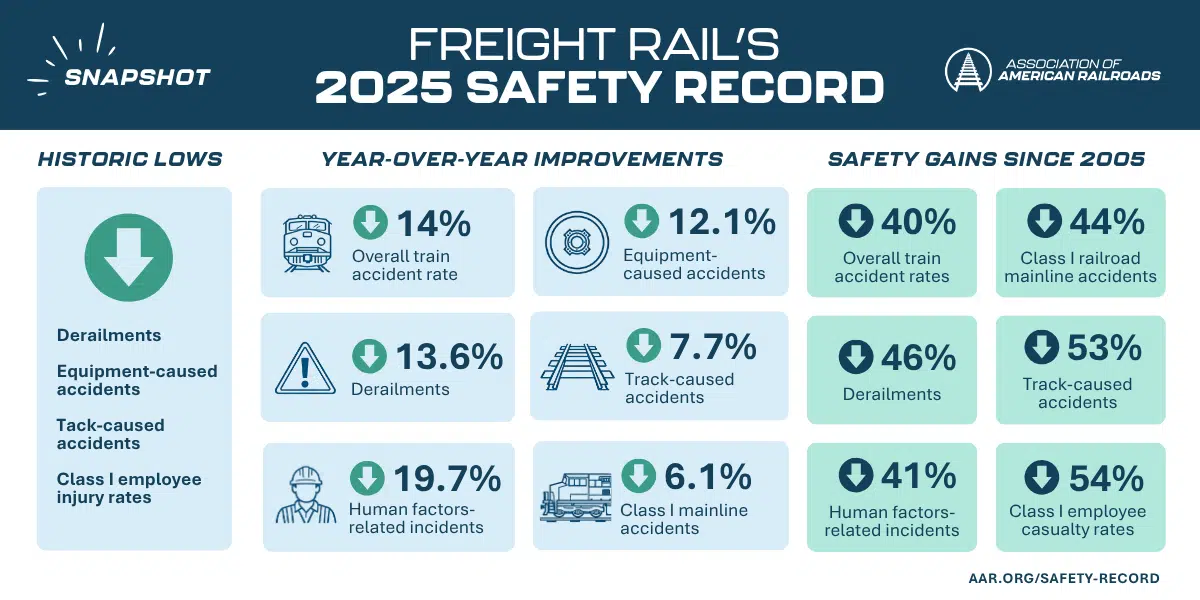
- Derailments, equipment-caused accidents, track-caused accidents, and Class I injury rates fell to historic lows in 2025.
- The overall train accident rate is down 14% year-over-year.
America’s freight railroads continue to make significant progress in safety. Data shows steady year‑over‑year improvements, strong long‑term gains, and clear evidence that ongoing investment in infrastructure and technology is paying off. This page provides a clear, easy‑to‑understand look at the industry’s safety performance — including both the progress made and the challenges that remain.
Year‑Over‑Year Safety Improvements
Freight railroads continue to reduce accidents and improve operational safety across the network. These improvements reflect advances in training, technology, maintenance practices, and safety culture throughout the industry. Year-over-year:
- The overall train accident rate down 14%
- Derailments down 13.6%
- Human factors-related incidents down 19.7%
- Equipment-caused accidents down 12.1%
- Track-caused accidents down 7.7%
- Mainline accidents down 2.8% industry-wide and 6.1% among Class I railroads
Long-Term Safety Gains Since 2005
The long-term trend is even more significant, with reductions that highlight the impact of sustained investment, innovation, and continuous improvement in safety practices. Since 2005:
- The overall train accident rates are down by about 40%
- Derailments are down by about 46%
- Mainline accidents are down by about 37% industry-wide and 44% among Class I railroads
- Track-caused accidents are down 53%
- Human factors-related accidents are down 41%
- Class I employee casualty rates are down 54%, reaching a record low in 2025
- On-duty fatalities are down by about 67%
Grade Crossing Incidents
Grade crossing incidents were essentially flat year over year and show only modest long‑term improvement. Because grade crossings involve shared spaces between roads and railroads, risks cannot be reduced by railroads alone. Programs such as the Grade Crossing Elimination Program and Section 130 grants play a crucial role in delivering measurable safety improvements. These initiatives help communities separate road traffic from train movements; improve visibility and signage; upgrade crossing protection technology; and target high‑risk locations. These programs underscore the need for ongoing collaboration, targeted investment, and policies that support proven safety solutions.
Human Factor-related Accidents
Further reductions in human factor–related accidents could be accelerated through the broader deployment of automation and advanced safety technologies. However, many rail operations are still governed by prescriptive regulations dating back to 1971, limiting the industry’s ability to adopt modern, performance‑based safety innovations. Updating these regulatory frameworks would allow railroads to apply technologies that can further enhance safety and consistency in operations.
The Role of Investment in a Safe Rail Network
Maintaining and advancing safety across the nation’s 135,000‑mile freight rail network requires sustained investment in track and infrastructure, workforce training, and advanced safety technology. Because freight railroads own, build, and maintain their own infrastructure, these investments support long-term cost efficiency, reliability, and supply chain stability. Each year, the industry invests about $25 billion of its own capital (six times more than the average U.S. manufacturer as a share of revenue) to strengthen and modernize the rail network.
What This Means for Communities and the Economy
Freight rail remains the safest, most efficient way to move goods over land and the industry’s long-term trajectory shows ongoing commitment to even greater safety. For the public, businesses, and the communities railroads serve, these safety improvements lead to:
- Safer rail operations nationwide
- Fewer disruptions to local roads and infrastructure
- Stronger worker protections
- A more resilient supply chain
- Continued modernization of critical transportation infrastructure
THE BOTTOM LINE
Freight rail safety continues to improve year after year, with accident and injury rates at historic lows due to sustained investment, advanced technology, and a strong safety culture. Over the long term, the train derailment rate has fallen by about 46% since 2005, demonstrating that continuous improvement is making the rail network safer, more reliable, and better equipped to move goods efficiently.