Key Facts
- Freight trains can run during storms, but only when conditions are safe and crews can confirm the track and rail infrastructure are safe to use.
- Flooding often damages what is underneath the rails — ballast, soil, drainage systems, and bridge foundations — not just the visible track.
- Railroads prepare before storms, monitor weather and river levels, inspect flooded areas, and use tools like drones, LiDAR, and sensors to assess damage.
🎧 Listen to this page • 6 min
Adapted for listening and narrated by a real person. Read the full narration at the bottom of this page.
Freight railroads run trains during storms only when conditions make it safe. All year they track weather, water levels and flood-prone stretches, pre-positioning crews, equipment and alternate routes. If a hurricane or other major storm threatens to flood the track, dispatchers slow, reroute or halt trains until the danger passes. Once the storm moves on, engineering teams inspect track, clear debris, and repair any damage. Normal service only resumes when it’s safe.
How do floods affect freight railroads?
While flooding can wash away rail track, it’s often the foundation beneath the track that disappears. Railroad track has several layers. Steel rails fasten to wooden or concrete ties, which sit on a thick layer of crushed stone called ballast. Beneath the ballast, carefully engineered layers of compacted soil support trains that can weigh more than 15,000 tons. Fast-moving water can:
- Wash away the ballast and soil that support the track
- Undermine bridge foundations through erosion known as scour
- Block culverts (what carries water beneath the railroad) with debris, which can cause flooding or erosion
- Drown signals, power-operated switches, and communications equipment
- Deposit trees, mud, and other debris across the track
- Trigger landslides or slope failures in mountainous areas
- Make damage difficult to see even after floodwaters recede
How do freight railroads prepare before flooding?
Freight railroads prepare for flooding long before storms arrive. They track weather, watch water levels, map flood-prone areas, stage crews and equipment, and keep drainage systems clear. Each step helps protect the rail network, limit service disruptions, and restore operations safely after extreme weather.
Forecasting and risk mapping
Railroads don’t wait for floodwater to reach the tracks. They use forecasts, storm-tracking tools, and GIS maps to identify trouble spots early. That includes flood-prone corridors, low-lying track, bridges, and culverts. Teams use data from the U.S. Geological Survey and the National Weather Service to monitor rainfall, flood watches, river and stream gauges, and upstream water levels. Some railroads also use commercial forecasting services.
Using technology to spot flood risks early
Technology helps railroads spot trouble early. Water-level sensors show where water is rising. Drones, satellite images, and field reports help crews see where track, bridges, or nearby ground may be at risk. LiDAR — a laser-based mapping tool that creates detailed 3D views of the ground — helps crews pinpoint where inspections or repairs should happen first.
For example, CPKC uses AI and satellite imagery to monitor more than 12,600 miles of track and 1.2 million nearby waterways. The technology looks for high water, washouts, beaver dams, and water moving too close to the tracks. The system reviews more than 3,000 satellite images each week. Crews receive results within four hours, so they can inspect problem areas, prioritize repairs, and prevent small issues from becoming major disruptions.
Keeping drainage systems clear
Good drainage can make a big difference before a storm. Freight railroads maintain thousands of culverts, ditches, and drainage structures that move water away from the track. Digital inspection records, maps, cameras, and field reports help teams find problem areas and decide what to clean first. That work lowers the risk that a blocked culvert will send water over the railroad or wash away its foundation.
Staging crews, equipment, and materials
When storms get closer, railroads move crews, equipment, and materials to the areas most likely to be hit. Crews stage ballast, ties, rail, generators, pumps, and heavy equipment so repairs can begin as soon as conditions are safe. They may also move railcars full of ballast onto certain bridges to guard against fast-moving floodwaters.
Can a train operate during a flood?
Freight trains can sometimes run during a flood, but only when it’s safe. Crews must confirm there isn’t more than a few inches of water above the rails, because deeper water can damage locomotive traction motors. They also need to know what the floodwater may be hiding. Washouts, damaged bridges, debris, and other hazards can be hard to see from a locomotive, and even shallow water can cover up major damage beneath the track.
If rising water threatens the railroad or inspectors can’t confirm the infrastructure is safe, railroads may slow, reroute, or stop trains until engineering inspections are complete. When one track segment becomes impassable, they can often reroute trains over another part of their system or onto another railroad. Standard operating agreements make that possible when unusual circumstances disrupt normal routes.
What do railroads do after a flood?
Once the water goes down, the work is far from over. Before trains can return to normal operations, engineering teams inspect bridges, track, ballast, drainage systems, signals, and communications equipment. They look especially closely at bridge foundations, embankments, and other places where fast-moving water may have washed away the ground beneath the railroad.
Crews also bring technology back into the picture. Drones and LiDAR help them see damage from above and map the ground in detail. These tools can reveal where floodwater washed away soil, damaged track, left debris, weakened bridge areas, or affected places crews can’t safely reach by road.
If the railroad needs repairs, crews may rebuild it from the ground up. They reconstruct embankments, repair drainage structures, compact new fill, place ballast, replace ties or rail, realign track, and complete follow-up inspections. Service often comes back in stages. Digital dispatching and network management systems help reroute trains, manage traffic, and reopen repaired sections once they pass inspection while crews keep working elsewhere.
The examples below show what that recovery work looks like in practice — from washed-out track and damaged bridges to full rebuilds that brought freight service back safely.
CSX rebuilt a vital Appalachian rail line after Hurricane Helene flooding.
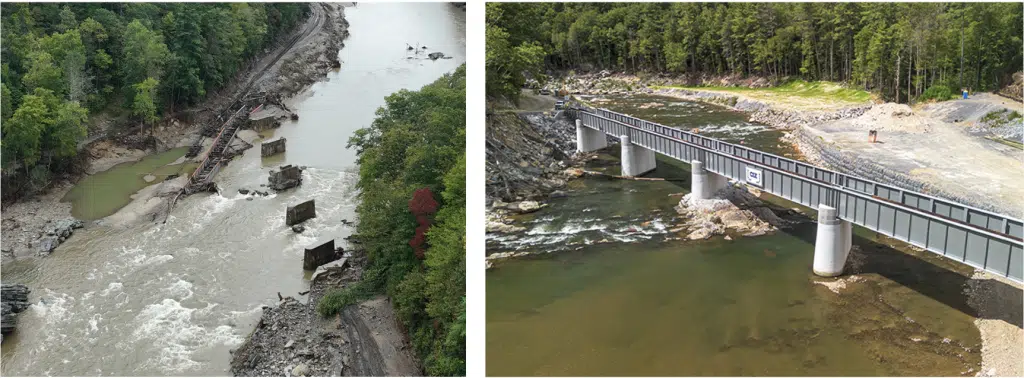
Damage and reconstruction efforts of CSX rail and bridge at Poplar Boat Ramp.
In 2024, Hurricane Helene brought catastrophic flooding to the Southern Appalachians and severely damaged about 60 miles of CSX railroad in eastern Tennessee and western North Carolina. Along the Nolichucky Gorge, floodwaters washed out railbed, damaged bridges, destroyed signals, and swept track materials into the river. CSX launched emergency recovery work. Teams pulled rail, ties, ballast rock, bridge spans, and other materials from the Nolichucky River and rebuilt rail beds, bridges, and culverts. The effort took nearly a year of time and investment, proving that railroads stay on the job until it’s safely done.
Norfolk Southern rebuilt a critical New Orleans rail bridge after Hurricane Katrina.
Hurricane Katrina washed nearly five miles of track off Norfolk Southern’s 5.8-mile Lake Pontchartrain Bridge, cutting off a critical rail route into New Orleans. Restoring service took a major engineering effort. Norfolk Southern crews used nine cranes mounted on barges to lift the track out of the water and put it back on the bridge. The railroad also repaired nine miles of damaged track in New Orleans, inspected 1,400 track miles, removed 5,500 downed trees, installed 11,000 ties, and placed 55,000 tons of ballast.
Canadian National rebuilt key British Columbia rail routes after flooding and landslides.
In November 2021, severe storms, flooding, landslides, and washouts shut down Canadian National’s British Columbia network between Nov. 14 and Dec. 4. The railroad reported 58 outages over 150 miles. About 400 employees and contractors worked around the clock to restore service. Crews moved roughly 282,000 cubic yards of rock, earth, and backfill to rebuild damaged locations. That equals about 25,000 truckloads. Canadian National also worked with emergency management officials and delivered medical equipment.
BNSF reopened a washed-out Cascades rail line in eight days
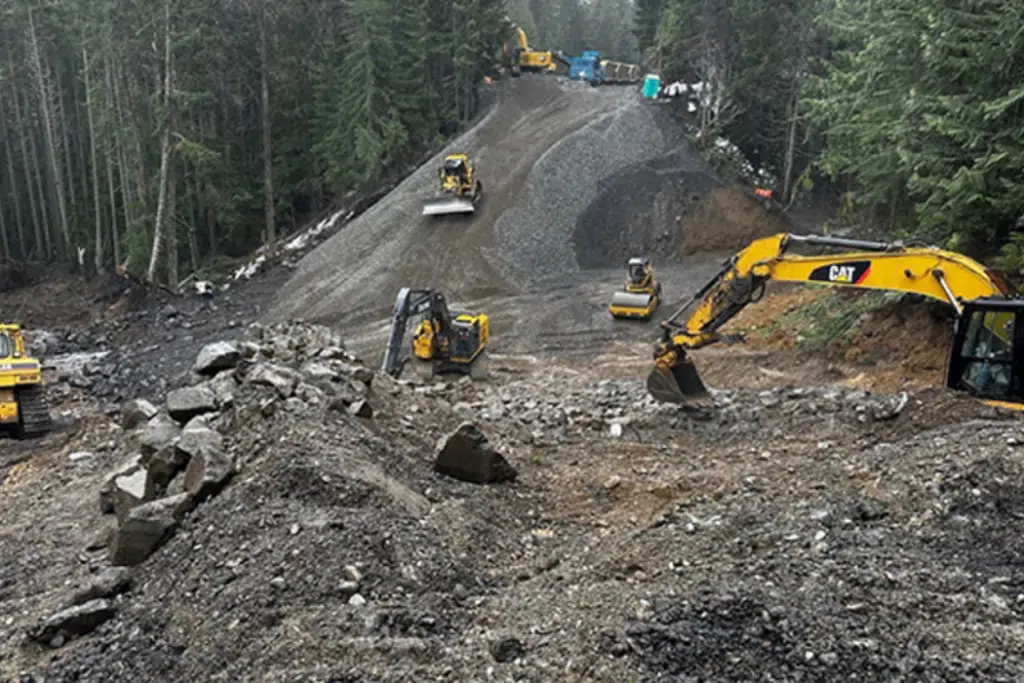
Torrential rain and fast snowmelt in Washington’s Cascades carved a 400-foot-wide, 60-foot-deep chasm beneath BNSF’s Stampede Pass main line on March 20, 2026. The damage left rail hanging in mid-air. BNSF halted trains, diverted traffic to other corridors, and moved heavy equipment over mountain roads and by rail to the remote site. Round-the-clock crews reopened the blocked creek. They installed two oversized culverts to handle future runoff, dumped and compacted more than 65,000 tons of rock to rebuild the embankment, and relaid and surfaced new track.
Union Pacific restored a Nebraska mainline in two days after flash flooding.
In 2015, heavy spring rains pushed the Little Blue River near Fairbury, Nebraska, more than eight feet above flood stage. The flooding washed out several stretches of Union Pacific’s Marysville Subdivision. Union Pacific’s Harriman Dispatching Center stopped train movements through the area for inspections, rerouted trains to avoid congestion, and coordinated with maintenance teams on the ground. Crews rebuilt the damaged track quickly and restored the mainline to service in just 46 hours.
Read the AAR Audio Narration
This is AAR Audio, and you’re listening to Can Trains Operate During Storms and Flooding?
Flooding can change a railroad in a matter of hours.
But preparing for it takes all year.
Freight railroads monitor weather, watch water levels, and prepare for the possibility that flooding could threaten part of the network.
Because when a storm arrives, every decision comes down to one question.
Is it safe to keep trains and employees moving?
While flooding can wash away rail track, it’s often the foundation beneath the track that disappears.
Railroad track is built in layers.
Steel rails sit on wooden or concrete ties.
The ties rest on crushed stone called ballast.
And beneath the ballast are carefully engineered layers of compacted soil.
Fast-moving water can wash away that foundation while leaving the rails looking perfectly normal.
But in reality, it may have little or no support underneath.
That’s a problem when the track was designed to support trains weighing more than 15,000 tons.
Flooding creates other hidden dangers too.
It can erode bridge foundations.
Block culverts that carry water beneath the railroad.
Damage signals, switches, and communications equipment.
Leave trees and debris across the track.
Or trigger landslides in mountainous areas.
Even after the water goes down, those problems aren’t always easy to see.
That’s why railroads never assume a flooded part of their network is safe simply because the rails are still there.
Let’s take a step back.
Preparation begins well before the forecast calls for rain.
Railroads continuously monitor weather conditions and water levels across their networks.
They use weather forecasts.
Storm tracking tools.
River and stream gauges.
And mapping technology to identify low-lying track, bridges, culverts, and other locations where flooding could become a problem.
The goal isn’t simply to react to a storm.
It’s to know where problems are most likely to develop before they happen.
Technology provides another layer of awareness.
Water-level sensors help identify where water is rising.
Drones and satellites show conditions across large areas.
LiDAR uses laser pulses to create detailed 3D maps of the ground, helping engineers identify erosion, washed-out embankments, and other damage.
Together, these tools help railroads decide where inspections and repairs should happen first before a storm is even forecasted.
Preparation also means getting people and equipment into position before the storm arrives.
Railroads move engineering crews closer to areas expected to be hit hardest.
They stage ballast.
Replacement rail.
Ties.
Generators.
Pumps.
And heavy equipment.
They also maintain thousands of culverts, ditches, and drainage structures designed to move water away from the railroad.
Keeping those drainage systems clear before a storm can make a tremendous difference when heavy rain begins.
So…
Can trains operate during a flood?
Yes, but only when crews can confirm the railroad is safe.
A few inches of water over the rails may not be the biggest concern.
The real question is what that water might be hiding.
Washouts.
Damaged bridges.
Debris.
Or missing ballast beneath the track.
If inspectors can’t verify the railroad is safe, trains slow down.
Get rerouted.
Or stop altogether.
Safety always comes first.
One advantage of a rail network is flexibility.
If one section of track becomes impassable, railroads can often reroute freight over another part of their own system.
Or, in some cases, over another railroad’s tracks.
Those decisions require careful coordination, but they help keep essential goods moving while damaged infrastructure is repaired.
Once the floodwaters recede, the recovery effort begins.
Engineering teams inspect bridges.
Track.
Ballast.
Drainage systems.
Signals.
And communications equipment.
They pay very close attention to bridge foundations and embankments, where fast-moving water may have washed away the ground beneath the railroad.
Some of the same technology that helped railroads prepare for a storm also helps them recover from it.
Drones and LiDAR can help identify washouts, erosion, debris, and damage in places that may be difficult—or unsafe—to reach.
If repairs are needed, crews may rebuild the railroad from the ground up.
They reconstruct embankments.
Repair drainage systems.
Pack down new soil.
Replace ballast.
Install new ties or rail.
Realign the track.
And inspect everything again before trains return.
Service usually comes back in stages.
As sections of railroad are repaired and inspected, dispatchers reopen them while crews continue working elsewhere.
Flood recovery doesn’t end when the track is repaired.
Railroads continue monitoring slopes.
Drainage systems.
And areas affected by erosion.
They reposition crews and equipment across the network.
Move delayed freight.
And help deliver many of the supplies communities need to recover.
Construction materials.
Fuel.
Food.
Utility equipment.
And countless other essential products.
Extreme storms and flooding are among the toughest weather challenges freight railroads face.
The danger isn’t always the water you can see.
It’s often the damage hidden beneath it.
That’s why railroads prepare long before storms arrive.
They monitor conditions as they change, inspect infrastructure and equipment, and restore service only after they know the railroad is safe.
The Bottom Line
Railroads monitor weather, water levels, and flood-prone areas year-round so they’re ready when storms bring flooding. They protect the network, reroute when needed, inspect for hidden damage, and restore service only when it’s safe.