Originally published in Railway Age.
Rand Ghayad, AAR Chief Economist, discusses what freight revealed in the first half of 2026:
Years ago, Warren Buffett was asked a simple question: if he were stranded on a desert island and could receive only one economic statistic each month, what would it be?
It was not GDP. Not inflation. Not unemployment, housing starts, or consumer confidence.
It was freight car loadings.
Railroads sit unusually close to the physical economy. Before factories ramp up production, grain reaches export markets, chemicals enter manufacturing processes, or construction materials arrive on site, something moves.
Freight is where economic activity becomes visible.
That perspective proved especially useful in the first half of 2026.
The headlines told us the dominant story was uncertainty. Consumer confidence softened. Businesses worried about tariffs and trade policy. Inflation concerns lingered. The labor market showed early signs of cooling. The narrative was one of an economy struggling to maintain momentum.
But the rail network told a different, less visible story. Not a story of booming growth, but one of rebalancing.
Think of the economy less like a single thermometer and more like an electrical grid. Individual parts of the system can come under strain without causing a broader failure. What matters is whether those stresses remain contained or begin spreading. During the first half of 2026, there were plenty of pressure points: persistent inflation concerns, policy uncertainty, a cooling labor market, and pockets of industrial weakness. Yet rather than cascading across the economy, those stresses remained surprisingly localized.
Instead, signs of strength began appearing across a broader range of freight-intensive sectors. Agriculture remained solid. Chemical shipments reached record levels. Manufacturing activity improved. Intermodal volumes regained momentum. While some traditional commodities softened, gains increasingly came from a wider set of markets.
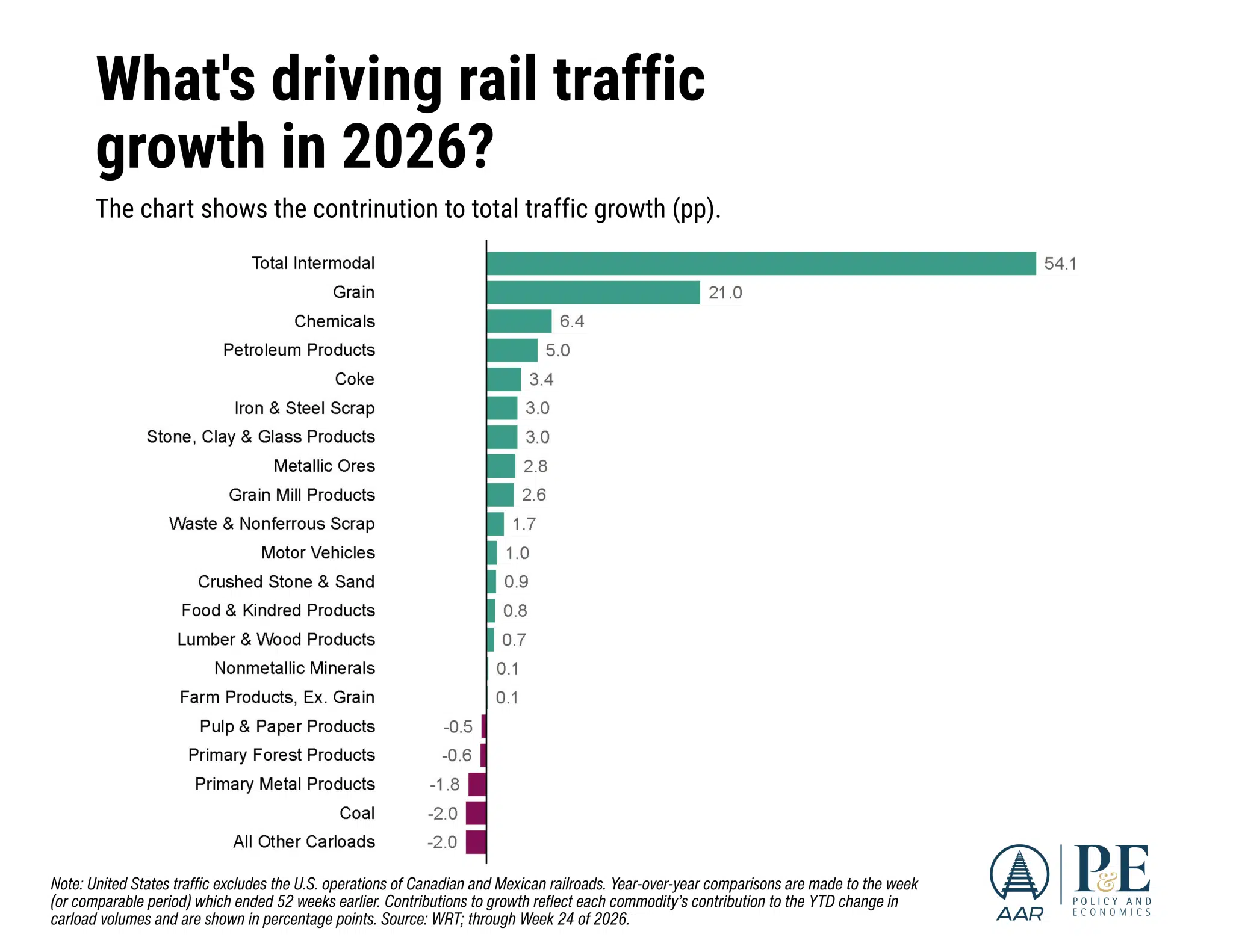
None of these developments, taken alone, would have stood out. Together, they pointed to something more meaningful: growth was becoming less concentrated. The goods-producing side of the economy was beginning to re-engage, and participation was spreading across a wider set of sectors.
That distinction matters.
For much of the past several years, the U.S. economy operated with an unusual imbalance. Services carried the expansion. Consumer spending remained resilient. Yet much of the goods economy lingered in the background. Manufacturing struggled to gain traction. Freight demand was uneven. Industrial activity lagged. Supply chains continued adjusting to the aftershocks of the pandemic, geopolitical tensions, and shifting trade patterns.
In 2026, that imbalance finally began to narrow.
The goods economy did not surge. It stabilized, then firmed, then broadened. That sequence is often how turning points begin—not with acceleration, but with participation.
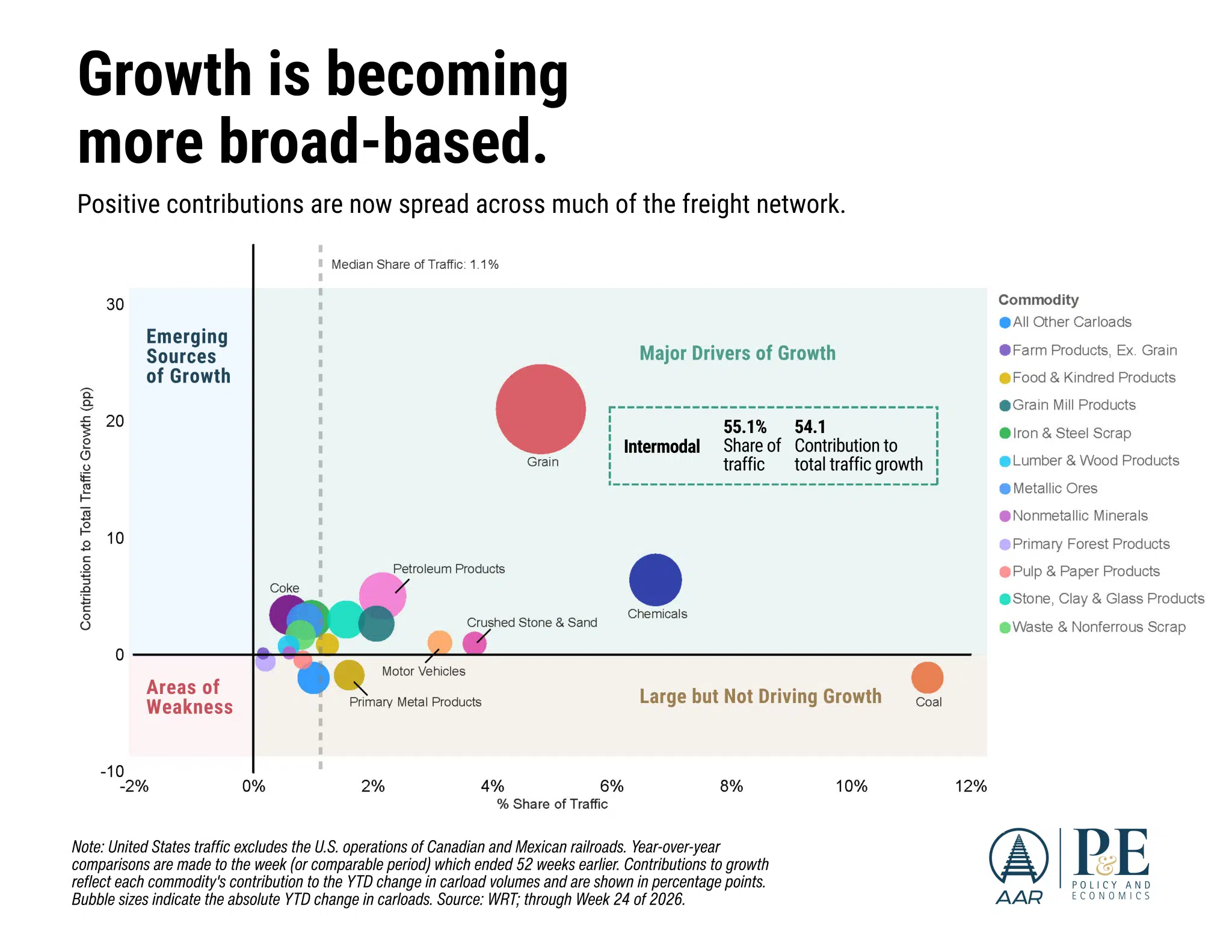
The story was no longer about a handful of commodities carrying freight growth. By midyear, positive contributions were coming from across much of the rail network, a sign that the recovery was becoming more broadly based.
That may be the most important economic development of 2026 so far.
What rail data increasingly revealed was the emergence of a second source of momentum. Manufacturing began to recover. Agricultural demand remained strong. Industrial production stabilized. Trade-related freight regained traction. The goods economy did not replace services as the primary driver of growth, but it started contributing again.
Economies tend to be more resilient when growth is supported by multiple sources of demand. A broader base of activity is often what separates a fragile expansion from a durable one.
Perhaps the most striking feature of this period was how little it aligned with sentiment.
Consumers expressed concern about the economy. Businesses remained cautious. Yet goods continued moving through supply chains at levels that pointed to a more resilient reality. The economy people described was not the economy they were participating in.
This does not make sentiment irrelevant. Confidence shapes decisions. Expectations influence investment. Financial conditions matter. But sentiment is not the economy itself. It is a reflection of it.
Freight sits closer to the point where decisions become actions. Orders become production. Production becomes movement.
That is why it’s so revealing.
Railroads touch agriculture, manufacturing, energy, construction, trade, and consumer demand. They provide a unique view into whether weakness is spreading or contained, whether activity is narrowing or diversifying, and whether growth is becoming more resilient.
In 2026, that signal was consistent.
The goods economy was returning.
Still, the risks have not disappeared. Inflation remains. Trade uncertainty continues to shape business decisions. The labor market bears watching. Some sectors still face structural headwinds.
But the broader picture is clearer than it was six months ago.
The economy did not simply avoid the slowdown many feared. It became more balanced.
After years in which growth depended heavily on consumers and services, manufacturing, agriculture, trade, and other freight-intensive sectors began contributing once again. A second engine came back online.
While not always visible in the headlines, the shift was visible in freight. And the movement of grain, chemicals, containers, steel, and industrial inputs often tells us more about where the economy is headed than the conversation surrounding it.
Freight does not speculate. It reflects decisions already made.
In 2026, it did more than track the economy. It clarified it.