RIO is a free monthly publication that provides insights from our economists into what rail traffic says about today’s economy and where the data suggests it could be headed. As part of RIO, the Freight Rail Index (FRI) tracks movement across the most economically sensitive rail traffic commodities. You can find the full report each month on this webpage, with past editions available as PDFs at the bottom of the page. Find past edition PDFs at the bottom of this page.
November 2026 Key Takeaways
- Yet another intermodal record. The past three months have been the top three U.S. intermodal months ever, including a new all-time high in October.
- Solid carload gains. Total carloads were up 3.4% year-over-year in October, the best percentage gain in eight months. Excluding coal, carloads rose 4.5% in October. Year-to-date total carloads are the most since 2019.
- Manufacturing expansion continues. Rail volumes are benefiting from a manufacturing expansion that shows no signs of an imminent slowdown.
- Significant economic challenges remain. Too-high inflation, rising interest rates, and weak consumer confidence are being countered by resilient consumer spending, an expanding service sector, industrial growth, and a still-low unemployment rate.
Rail traffic says the economy is stronger than it feels.
October was a standout month for U.S. railroads. Intermodal rose 9.6% over last year and set an all-time monthly volume record. Total carloads rose 3.4%, their biggest percentage increase in eight months. Excluding coal, carloads rose 4.5%, above average for the year and far higher than the 2021-2025 average of 1.7%.
Just as important as the size of the gains is their breadth. For months now, growth has spanned most traffic categories. That is the signature of broad industrial resilience, not a one-off and not just market share gains from trucks, and it points to further growth in the months ahead.
To be sure, the economy faces serious challenges: high inflation and interest rates, spillovers from conflicts abroad, an uncertain labor market, and low consumer confidence, to name a few. Still, despite the pressures many households are facing, data continue to show an economy with underlying resilience, especially in the industrial and consumer goods sectors that matter most to railroads.
Another rail intermodal record was reached.
U.S. railroads averaged more than 298,000 intermodal units per week in October 2026, the highest weekly average ever for a month. Historically, October is the best intermodal month of the year, reflecting “peak season” when higher-than-normal shipments of goods move through supply chains in preparation for the holidays.
October was especially strong this year: it had the first, third, and fifth-best intermodal weeks ever. Year-to-date intermodal volume was up 4.7% through October, and this year will set a new annual record.
The factors that have led to higher intermodal volume in recent months were largely unchanged in October: high diesel, insurance, and maintenance costs for truckers; fewer available truck drivers; and solid rail service performance. In addition, consumer spending is holding up well and some retailers have begun to restock inventories that have fallen too low, providing more impetus for additional intermodal movements.
Broad carload growth continued.
Of the 20 carload categories the AAR tracks, 15 saw year-over-year gains in October. For the year to date, 16 of the 20 categories are up. This broad growth shows demand is solid across much of the industrial economy, not just in a handful of sectors.
Motor vehicles led the way for U.S. railroads in October, with carloads up nearly 10%, or 5,900 carloads, over last year in response to strong buyer demand. Adding in Canadian and Mexican railroads brings October’s gain to more than 8,000 carloads, or 9% — their biggest percentage gain since December 2023. Year-to-date carloads of motor vehicles are up slightly over last year.
Several other carload categories also had standout October results. Carloads of petroleum products were the most since February 2020; carloads of iron and steel scrap were the most since September 2008. October 2026 was the best October for carloads of steel products since 2018; October 2026 set a new October record for carloads of grain mill products.
The key point is that rail volumes are not just outperforming last year or the year before. Across many categories, they are reaching multi-year highs, suggesting that strength in rail traffic today reflects genuine momentum in freight markets and the broader economy.
For the first 10 months of 2026, U.S. grain carloads were up 10% (92,000 carloads) to lead all carload categories. However, grain carloads in October were down for the first time in a year. Most variability in grain carloads is associated with grain exports. In the first half of 2026, grain exports were up 13% by volume over last year, but they were down in the third quarter. Railroads account for around 40% of U.S. grain exports, according to USDA data.

Today, only intermodal generates more rail revenue than chemicals. Carloads of chemicals rose in October at their fastest pace in seven months and are virtually certain to set a new annual record this year. Thank the resurgence in manufacturing this year. Chemicals’ persistent gains have quietly made it a top performer for U.S. railroads over the past couple of years.
Coal remains the soft spot, though October offered a glimmer: carloads rose fractionally year-over-year after seven straight declines. Year to date, they are down 1.6%. U.S. electricity generation from coal is down in 2026, though higher coal exports (which mostly move by rail) are countering that decline to some extent.
Adjusted for inflation, U.S. natural gas prices over the last six months have averaged about 25% less than their average over the last decade. This has made electricity generated from natural gas more competitive vis-à-vis coal-fired electricity, creating a headwind against rail coal volumes.
The AAR Freight Rail Index (FRI) strips out coal and grain and seasonally adjusts the rest, giving a clean read on economically sensitive rail traffic. The index has trended steadily higher this year. In October, it hit its second highest level on record, pointing to healthy demand across a wide range of industrial and consumer markets.

Rail cars in storage tell the same story: when demand for rail service rises, railroads and other railcar owners pull idle cars back into service. In October, the number of cars in storage fell for the eighth time in the past 9 months and now equals 17.5% of the North American railcar fleet — the lowest share since December 2022.
There were real headwinds, but also more bright spots than the mood suggests.
If the recent election is any indication, Americans have lost patience with inflation. It’s easy to see why: average consumer prices were 23% higher in September 2026 than five years earlier, and the five-year inflation rate has topped 20% each month since mid-2022, something that hadn’t happened since early 1994. Other economic caution flags today include rising interest rates (including mortgage rates that are at three-year highs), weak consumer confidence, and housing affordability issues.
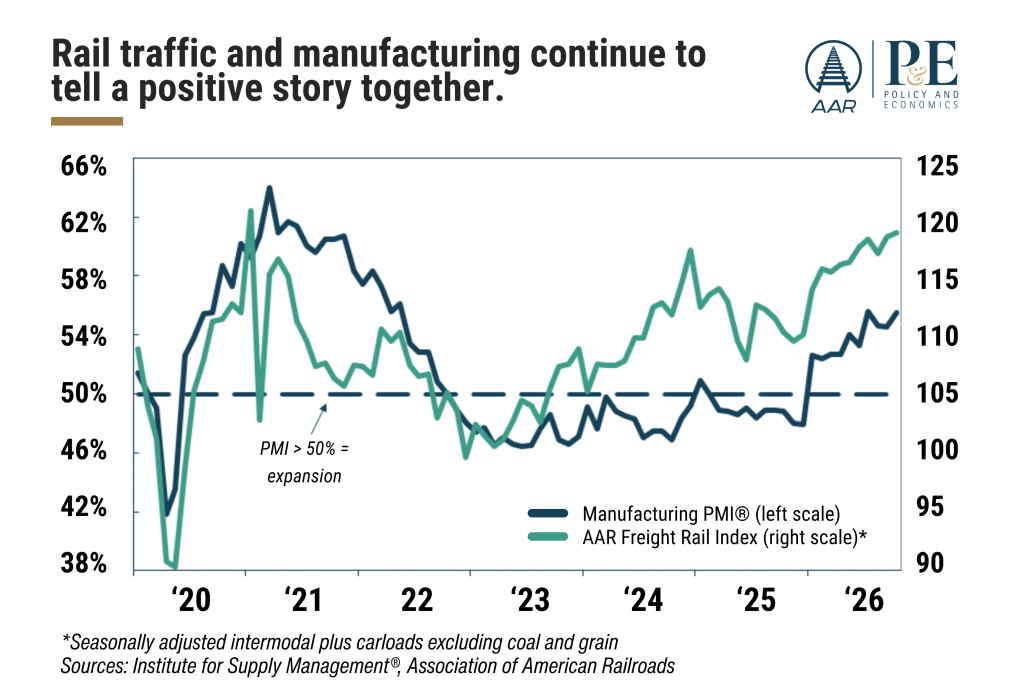
But sentiment is only part of the story, and much of the hard data looks considerably better. Preliminary data show U.S. GDP grew 3.4% in Q3 2026, while a measure that excludes trade and inventories rose 4.9%, indicating solid domestic demand. The unemployment rate, at 4.1%, remains well below its historical norm, and layoffs are relatively low.
A preliminary 165,000 net new jobs were created in October, bringing the average gain over the past three months to a more than respectable 137,000. The services sector is expanding, and manufacturing is as well: the Manufacturing PMI® was in expansion territory in October for the 10th consecutive month, while manufacturing output in recent months has been the highest since early 2022. Consumer spending also continues to grow at a healthy pace.
Economic indicators never all point in the same direction, and policy shifts after the election could add uncertainty in the months ahead. But on balance, the data suggest the economy is still expanding at a solid pace. Rail volumes have been signaling that strength all year, and we expect them to keep growing into 2027.