Key Facts
- Freight rail helped turn America into a connected national economy.
- From farms to factories to e-commerce, rail has powered every major era of growth.
- Today’s freight rail network keeps America moving safely, efficiently, and affordably.
🎧 Listen to this page • 10 min 24 sec
Adapted for listening and narrated by a real person. Read the full narration at the bottom of this page.
For nearly 200 years, freight railroads haven’t just moved America’s economy—they’ve helped create it. They connected a young nation that was too large to efficiently cross, opened the West and Midwest to commerce, powered industrialization, and made it possible for businesses to grow beyond local markets.
Along the way, railroads introduced innovations that extended far beyond transportation, from standardizing time and pioneering modern management to transforming food distribution, retail, and nationwide communications.
Many of the systems that are part of our everyday lives were first made possible—or dramatically accelerated—by freight rail. The milestones below show how railroads helped shape the country’s economic development, technological progress, and growth into a national marketplace. Nearly two centuries later, freight rail continues to play that same essential role, moving the raw materials, food, energy, and consumer goods that power America’s future.
1820s–1840s: Shrinking a Continent

A painting by Herbert Stitt shows the meeting where the charter was approved to formally establish the B&O railroad.
The chartering of the Baltimore & Ohio Railroad in 1827 marked the beginning of a national transportation revolution. Before rail, moving goods inland was slow, expensive, and deeply unreliable. Large quantities of goods or raw materials simply could not be moved efficiently.
Freight traveled by horse-drawn wagons over rough, often impassable roads or along canals that were limited in reach, froze in winter, and faced inconsistent water levels. Shipments were expensive and could take weeks—or longer—to travel just a few hundred miles, making economic growth difficult.
Railroads changed that almost overnight. By moving goods faster, more reliably, at far lower cost, and in much larger quantities, they cut travel times from weeks to days and made year-round, long-distance commerce possible. For a young and expanding nation, that shift was enormous. Communities that had been isolated were suddenly connected to markets, ports, and opportunity—helping turn a vast, fragmented landscape into a unified and dynamic economic system.
1850s: Opening the Midwest
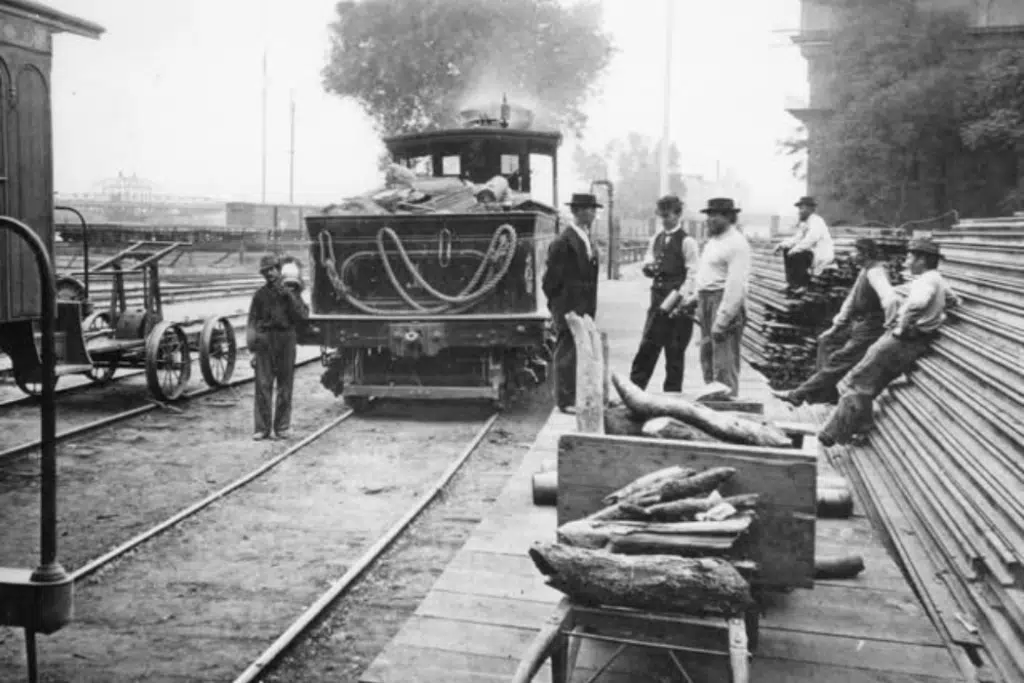
Workers gathered near the Gov. Stanford locomotive in Sacramento during the 1860s construction of the Transcontinental Railroad.
By the 1850s, railroads were rapidly pushing west, turning the Midwest from isolated, frontier farmland into a cornerstone of the American economy. Before rail, farmers were limited to what they could sell locally or transport by wagon to nearby waterways—a slow, costly process that ate into profits.
Rail changed that equation. Grain, livestock, and other commodities could now move hundreds of miles quickly and reliably to eastern cities and ports, opening national and even global markets.
Towns started to spring up along rail lines—often spaced by the distance a train could travel in a day—while existing communities boomed as new rail connections arrived. Land values surged, grain elevators and stockyards rose alongside tracks, and entire supply chains began to organize around rail access. Standardized track gauges, adopted in the post–Civil War era, further accelerated growth by allowing seamless connections between rail lines, creating a truly integrated network.
By giving farmers predictable access to markets, freight railroads encouraged larger-scale production and long-term investment. In just a few decades, the Midwest went from sparsely populated farmland to one of the most productive agricultural regions in the world. Today, it remains a cornerstone of American agriculture thanks in large part to freight railroads.
1861-1865: The First Railroad War

The “Dictator” mortar near Petersburg, Virginia, in 1864, demonstrating the Civil War innovation of mobile rail-mounted artillery.
The Civil War demonstrated that railroads had become essential to the nation’s strength. For the first time in history, rail was used on a massive scale to move troops, weapons, food, horses, ammunition, and medical supplies quickly across long distances, transforming military logistics. The Union’s larger and more connected rail network gave it a decisive strategic advantage, allowing armies to reinforce positions, replace supplies, and sustain military operations at a speed that had never before been possible.
The war also accelerated railroad innovation. Military leaders and railroad operators worked together to coordinate train movements, repair damaged track, and keep vital supply lines open under extraordinary conditions. When the war ended, many of the logistics practices, operational improvements, and infrastructure investments developed during the conflict carried over into peacetime, helping railroads expand westward and further integrate the American economy.
1860s–1880s: Building a National Economy
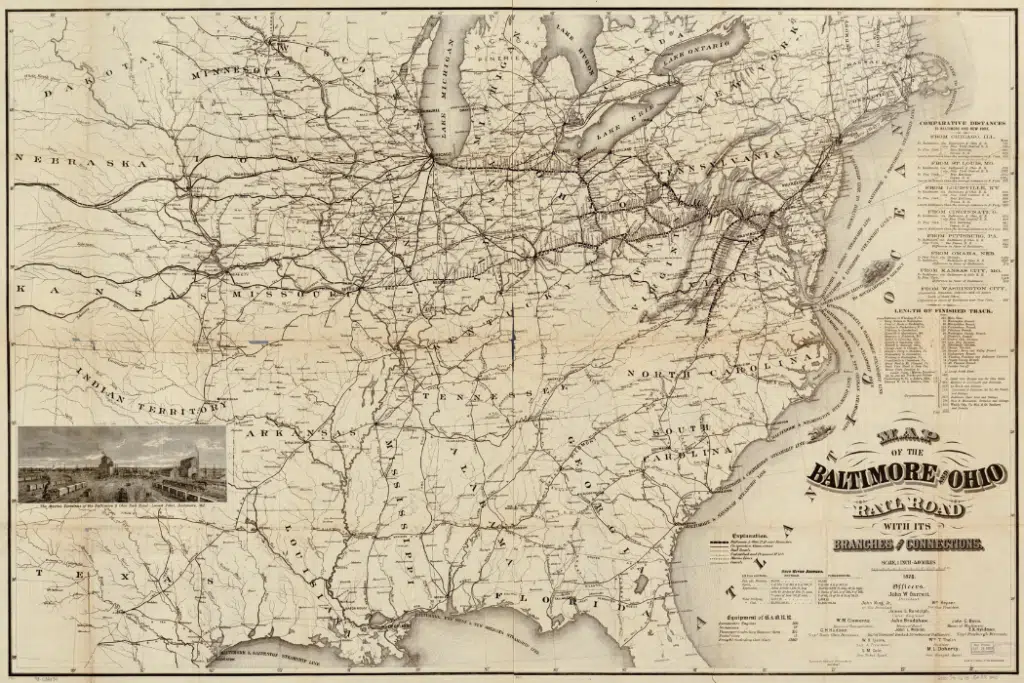
A comprehensive 1876 Rand McNally & Co. map outlining the expansion of the B&O Railroad and its connecting lines across the Eastern and Midwestern U.S. (LOC).
As rail networks expanded and linked together, they created something entirely new: a truly national marketplace. Cities like Chicago, St. Louis, and Kansas City emerged as major rail hubs, where raw materials, agricultural products, and manufactured goods converged and were redistributed across the country.
Published schedules brought a level of predictability that didn’t exist before, allowing businesses to plan production, manage inventory, and operate at a much larger scale. Railroads also enabled entirely new industries to grow, from steel and machinery to consumer goods, by ensuring steady access to both inputs and customers.
Just as important, railroads helped standardize pricing and supply across regions. Goods that were scarce or expensive in one area could be moved efficiently from places where they were abundant, smoothing out shortages and stabilizing markets. Large freight yards, warehouses, and early distribution centers took shape along major lines, creating the physical backbone of a national supply chain.
For the first time, the U.S. economy functioned as an interconnected system, where businesses could expand with confidence beyond regional boundaries, helping lay the foundation for modern American industry.
1870s–1890s: Inventing Modern Management
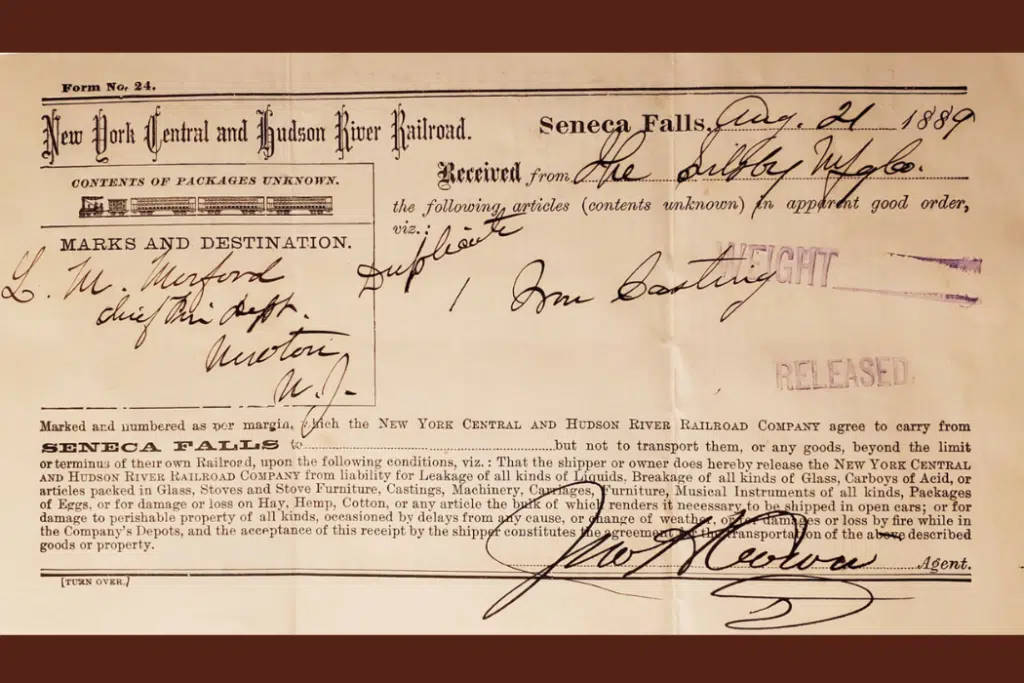
A late-19th-century shipping receipt documenting an iron casting shipment.
Running large railroads required coordinating thousands of employees, locomotives, railcars, and schedules across multiple states—far more complex than any previous enterprise. Every train movement had to be precisely timed and sequenced on shared tracks, with dispatchers, station agents, and crews all working in sync to keep traffic flowing safely.
Delays in one location could ripple hundreds of miles down the line, forcing railroads to think in terms of systems, not individual operations. Managing that level of complexity demanded new tools, new roles, and a fundamentally new way of organizing work.
To meet the challenge, railroads pioneered many of the systems that define modern business today. They introduced formal organizational hierarchies with clear lines of authority, separated operations into specialized departments, and developed standardized reporting so leadership could track performance across vast networks.
Detailed cost accounting and efficiency metrics emerged to manage expenses and improve decision-making, while the need for trained managers gave rise to professional management as a discipline. These weren’t just incremental changes—they were a new blueprint for running large organizations. In many ways, the template for corporate America was first built to keep trains running on time.
1883: Standardizing Time
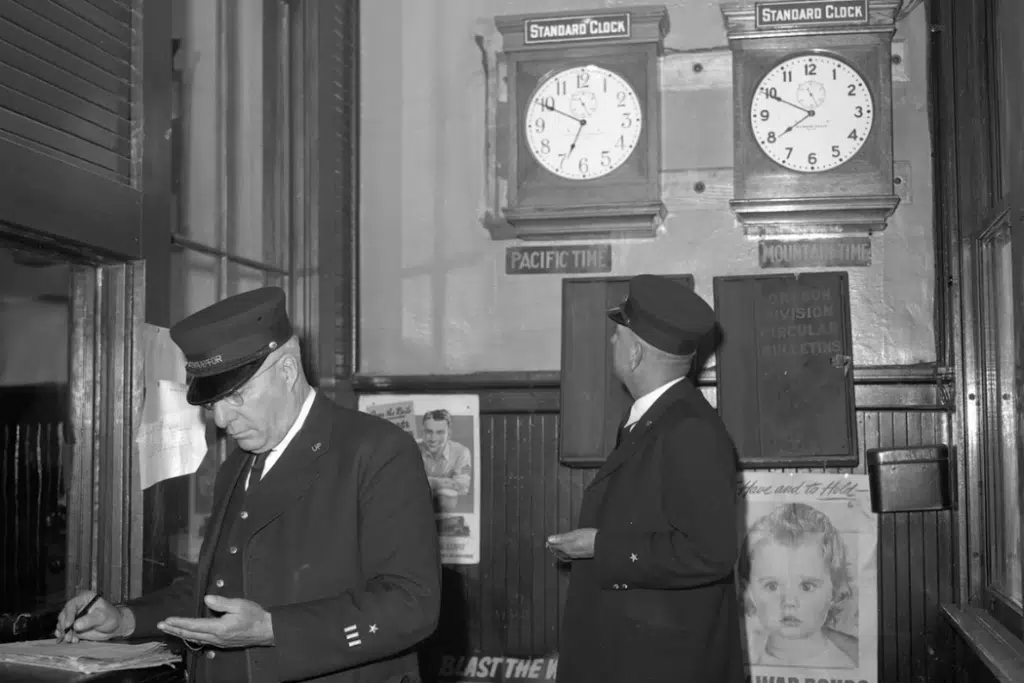
Two Union Pacific railroad employees check and synchronize time inside a station depot. Courtesy UP Railroad Museum.
Before the 1880s, time was local—literally. Cities and towns set their clocks by the sun, meaning noon in one place could differ by minutes from the next stop down the line.
For railroads trying to run precise schedules across hundreds of miles, that patchwork created constant confusion, missed connections, and real safety risks. A single train moving through multiple towns could encounter a different “time” at each stop, making reliable coordination nearly impossible.
On November 18, 1883, railroads solved the problem themselves by introducing four standardized time zones across the United States. Known as “The Day of Two Noons,” communities adjusted their clocks—some jumping forward, others back—instantly creating a consistent system that trains, businesses, and the public could rely on.
The change brought immediate order to rail operations and quickly spread to everyday life, synchronizing everything from factory shifts to commerce. It was a private-sector solution to a national problem—so effective that the federal government later made it official.
1880s–1900s: Revolutionizing Food Supply

A refrigerated car built in 1899. (Chicago Historical Society).

The introduction of refrigerated railcars in 1851 fundamentally changed how Americans ate. Before their widespread use towards the end of the century, perishable goods had to be consumed close to where they were produced, and diets were largely seasonal and regional.
Refrigerated cars—and, earlier, ice-cooled boxcars—made it possible to safely ship meat, dairy, and produce over long distances without spoilage. This change opened entirely new markets for farmers and ranchers. The impact reshaped both agriculture and daily life. Chicago emerged as the center of the nation’s meatpacking industry, supplying cities across the country, while fruits and vegetables from California and Florida could reach distant markets in good condition.
Entire supply chains—from farms to packing houses to rail lines—began to coordinate around this new capability. What had once been local and seasonal became national and year-round, helping create the modern grocery store and the integrated food system Americans rely on today.
1890s–1910s: Powering Mail-Order America
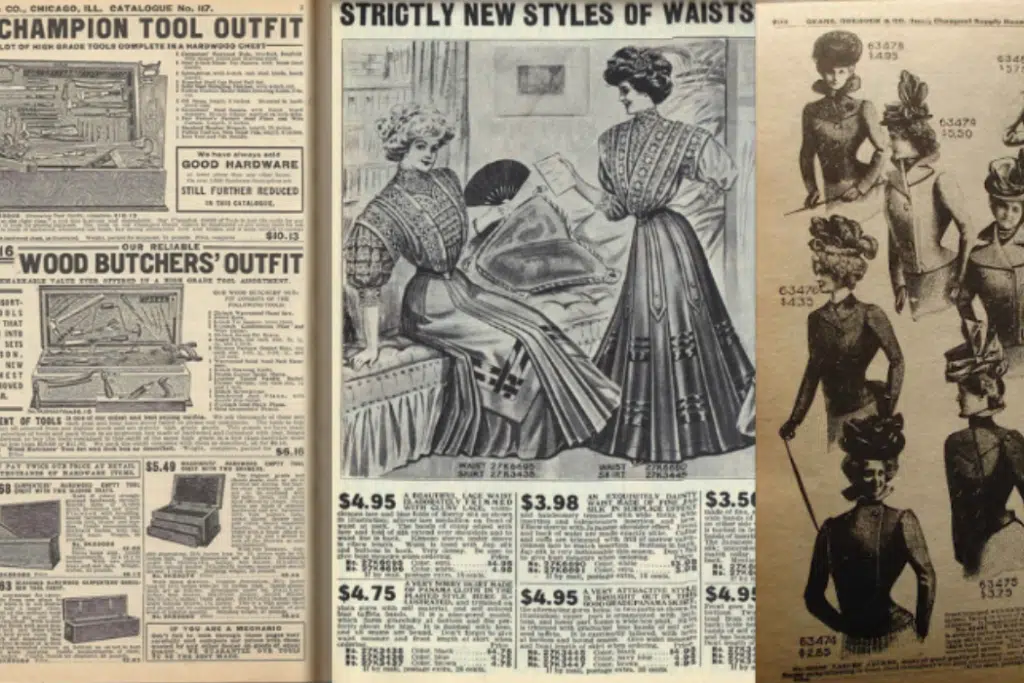
Example of pages inside Sears Mail Order Catalog in the early 1900s.
Railroads enabled the first nationwide retail revolution. Companies like Sears and Montgomery Ward built massive mail-order businesses by pairing rail delivery with an expanding postal network, shipping everything from clothing to farm equipment (and even prefabricated homes) directly to railway stations for pickup.
Thick catalogs became fixtures in American homes, especially in rural areas, where local stores carried limited and often higher-priced goods. The result was truly transformative. Rail-connected distribution centers and depots allowed orders to be processed and shipped at scale, bringing consistency, wider choice, and more competitive pricing to consumers across the country.
For millions of Americans, it was the first time they could reliably access the same goods as shoppers in major cities. Long before online shopping, this system turned the entire country into a single, accessible marketplace—reshaping consumer expectations and laying the groundwork for modern retail.
1917-1918: Mobilizing for World War I

While larger trains hauled supplies across the country, compact trench engines like this Baldwin handled the most dangerous leg of the journey—delivering heavy shells, timber for bunkers, and food directly to the soldiers in the mud.
When the United States entered World War I in 1917, freight rail became the backbone of the nation’s military logistics. Railroads moved millions of soldiers to training camps and ports while transporting weapons, ammunition, food, fuel, and raw materials between factories, shipyards, and military installations. No other transportation system could move people and supplies at the speed or scale required to support the war effort.
The unprecedented demands of wartime also exposed the importance of a coordinated national rail network. Railroads worked together to maximize capacity, improve operations, and keep critical freight moving under extraordinary pressure. The experience on demonstrated that freight rail was not only essential to America’s economy—it had become a strategic national asset capable of mobilizing the country in times of crisis.
1910s–1930s: Connecting America in Real Time
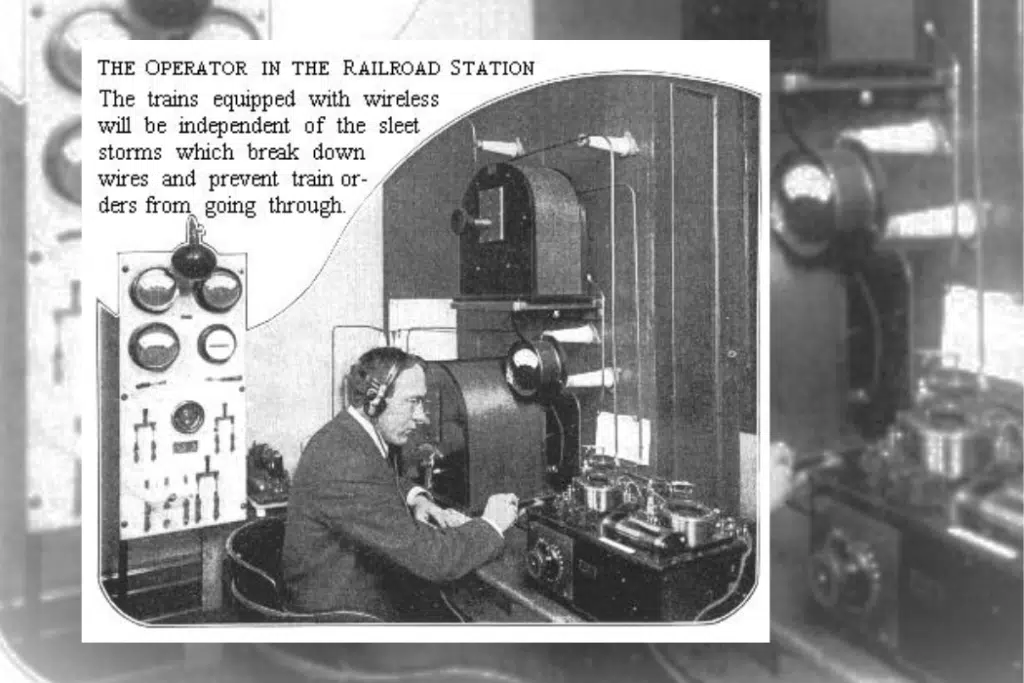
A railroad wireless operator at a land station transmits orders to moving trains. (Technical World Magazine, Feb. 1914)
To operate safely and efficiently, railroads built extensive telegraph networks that allowed dispatchers to communicate instantly across long distances. This capability made it possible to coordinate train movements with precision, avoiding collisions and maximizing the use of track.
In an era before digital technology, railroads created one of the most advanced communications systems in the country. It was effectively an early, analog version of a connected network where information moved as strategically as freight.
1940s: Winning World War II
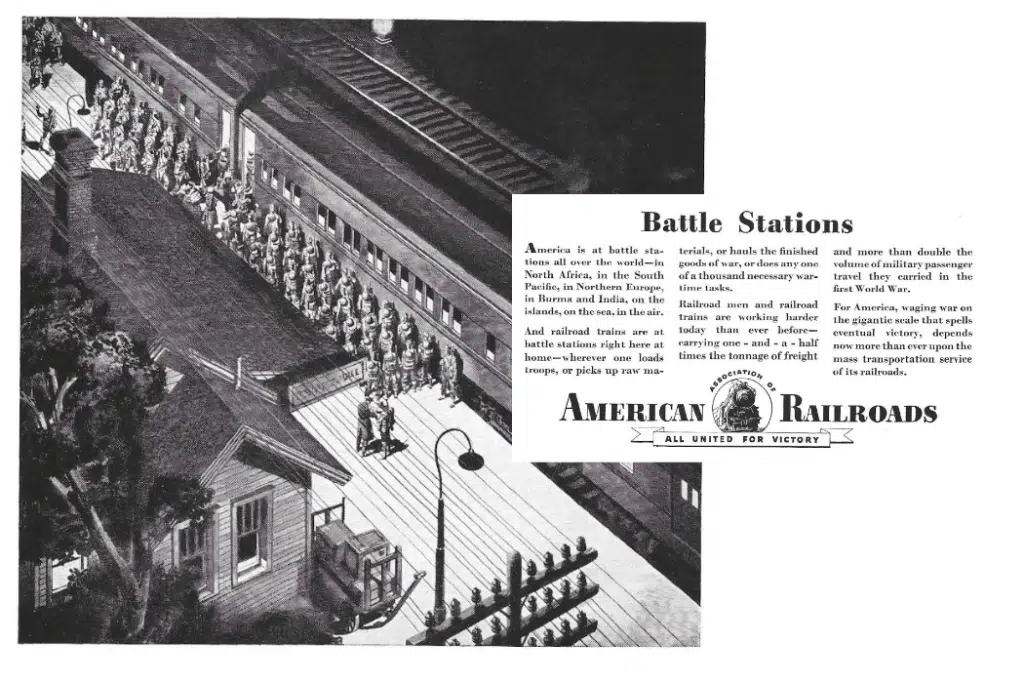
“Battle Stations” – A 1943 wartime ad from the AAR highlighting the critical role of domestic rail transportation in securing victory during World War II.
During World War II, freight rail was critical to the American war effort. Railroads moved enormous volumes of troops, tanks, aircraft components, ammunition, fuel, and raw materials between factories, ports, and military bases at a scale no other transportation system could match.
With gasoline and rubber rationed, rail carried the overwhelming majority of long-distance freight and passenger traffic, helping transform America’s industrial capacity into the “Arsenal of Democracy.” The logistics systems refined during the war demonstrated how a coordinated national freight network could support both military readiness and economic resilience.
1950s–1960s: Building Modern Manufacturing

An American family gathers around a black-and-white television set in 1958, capturing a glimpse into post-WWII suburban life. (Baumgardner, Evert F. U.S. National Archives.)
America’s postwar boom changed nearly every corner of the country. Millions of new homes were built, the Interstate Highway System reshaped transportation, factories expanded production, and consumer demand surged. Meeting that growth required an unprecedented movement of steel, cement, lumber, automobiles, chemicals, and energy—much of it carried by freight rail.
Railroads supplied the raw materials that built the nation’s suburbs, highways, and manufacturing base while delivering finished goods to markets across the country. At the same time, diesel-electric locomotives, centralized traffic control, and larger freight cars dramatically increased capacity and reliability. This progress allowed American industry to produce and distribute goods at a scale never before possible.
1971: A New Era for Passenger Rail
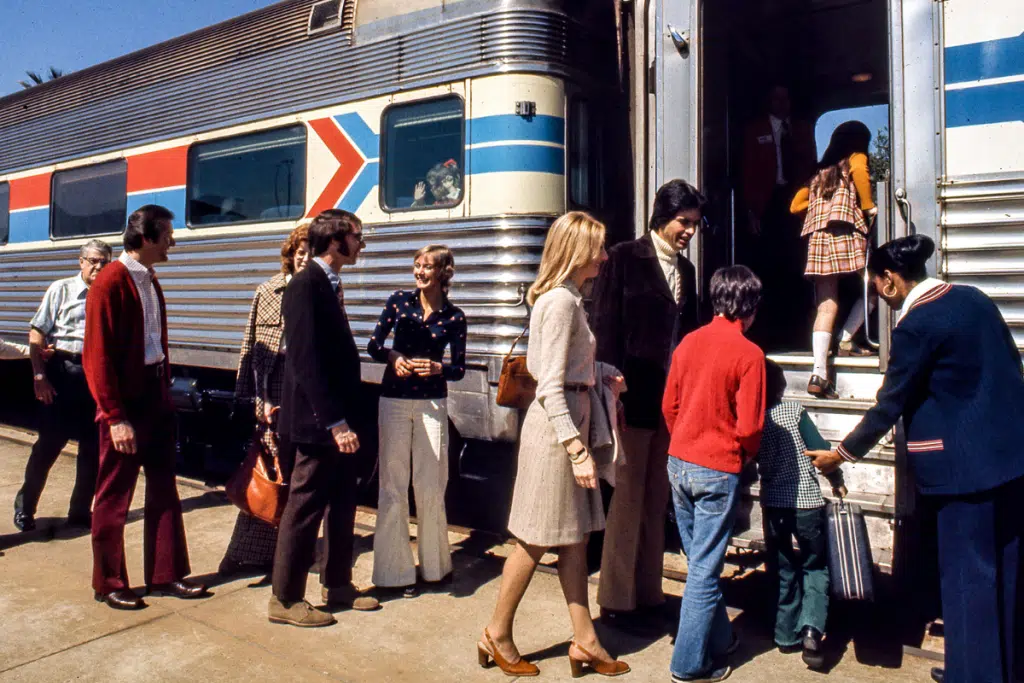
The creation of Amtrak in 1971 marked a major turning point in American railroading. For more than a century, private freight railroads had also operated most of the nation’s intercity passenger trains. As automobiles and air travel grew in popularity, passenger service became increasingly unprofitable, leading Congress to establish Amtrak to assume responsibility for most intercity passenger operations.
The transition allowed freight railroads to focus on moving the goods that power the American economy while continuing to provide the infrastructure that supports passenger travel. Today, more than 70% of Amtrak trains operate on tracks owned, maintained, and dispatched by freight railroads, reflecting the enduring partnership between the nation’s freight and passenger rail systems.
1980s: Reinventing Freight Transportation
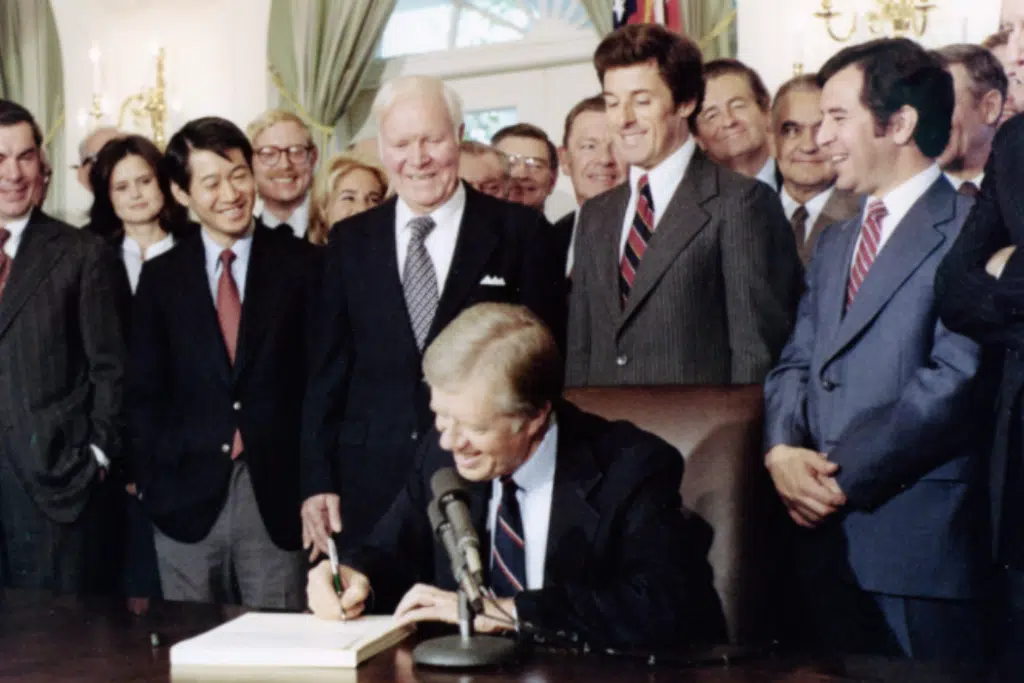
President Jimmy Carter signs the Staggers Rail Act into law at the White House, October 14, 1980.
Even as freight railroads continued delivering the raw materials, agricultural products, and manufactured goods that powered the American economy, the industry itself was being strangled by decades of rigid federal economic regulation.
By the 1970s, because of excessive regulation, railroads had virtually no flexibility to adjust rates, discontinue unprofitable routes, or respond to changing customer needs, even as trucking and pipelines captured increasing market share.
The result was predictable: deferred maintenance, deteriorating infrastructure, declining service, worsening safety, and the bankruptcy of several major railroads—putting at risk the very network that had helped build America’s industrial economy.
The Staggers Rail Act of 1980 fundamentally changed that trajectory. By partially deregulating the freight rail industry and restoring greater market flexibility, the law allowed railroads to reinvest in their infrastructure, modernize operations, and compete more effectively.
The transformation was dramatic. Railroads rebuilt their networks, adopted new technologies, improved safety and productivity, and reduced shipping costs for customers. What had been an industry in decline became one of the greatest turnarounds in American history. The Staggers Act laid the foundation for today’s modern freight rail network, with a level of safety, reliability, and cost effectiveness that is the envy of the world.
1980s–2000s: Powering Global Trade
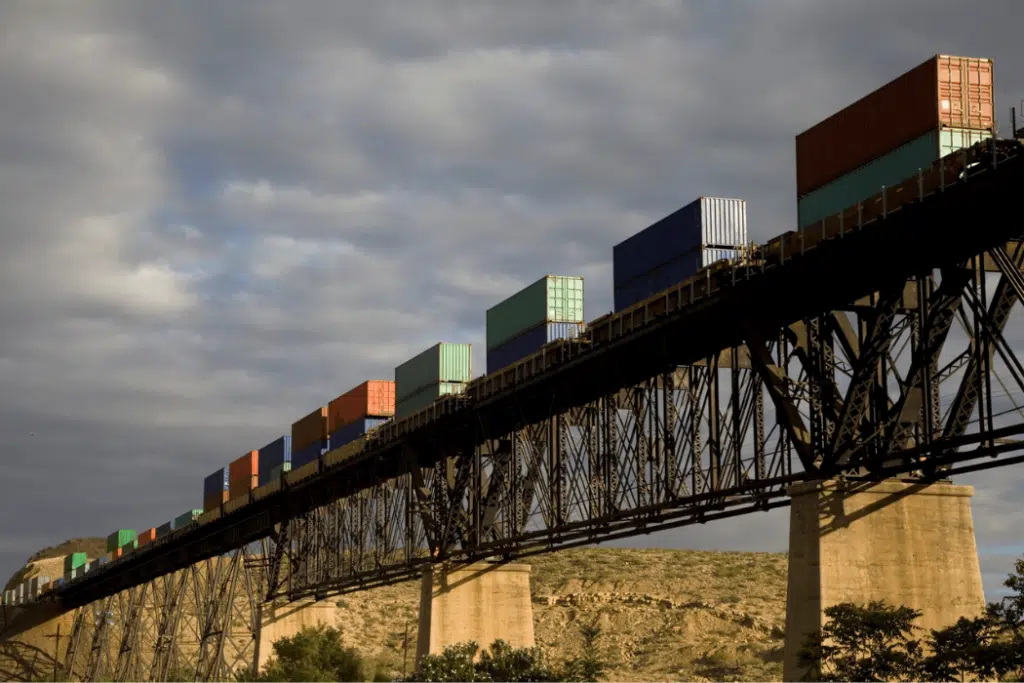
Example of today’s modern intermodal shipping containers moving by freight rail.
As international trade expanded and container shipping revolutionized the movement of goods, supply chains became increasingly global. Products were no longer manufactured entirely in one place—they crossed oceans, borders, and transportation networks before reaching consumers.
Freight rail became the essential inland link connecting ports with factories, distribution centers, farms, and cities across North America. The rapid growth of intermodal transportation, along with double-stack container trains, advanced logistics systems, and modern terminals, enabled goods from around the world to move efficiently across the continent and helped make today’s integrated global economy possible.
1990s–2010s: Enabling the E-Commerce Economy

Ebay homepage in 2005.
As the internet transformed the way Americans shopped, retailers began supplying massive distribution and fulfillment centers capable of serving customers nationwide. Behind every online purchase was (and still is) a complex logistics network moving imported goods from ports, consumer products from manufacturers, and inventory between warehouses.
Freight rail provided (and still provides) the long-haul backbone of that system. By expanding intermodal networks, investing in high-capacity corridors, and partnering with ports, trucking companies, and distribution centers, railroads enabled enormous volumes of goods to move efficiently across the country. Those investments helped make the speed, scale, and reliability of modern e-commerce possible—allowing retailers to replenish inventory quickly and deliver products to millions of Americans.
Today

Two freight rail employees work in a high-tech intermodal operations facility.
For nearly 200 years, freight rail has evolved alongside America’s economy. As the country enters another period of transformation—driven by advanced manufacturing, artificial intelligence, expanding energy infrastructure, and more resilient supply chains—freight rail is once again adapting to meet the moment.
Every day, America’s freight railroads move the raw materials, agricultural products, energy, automobiles, and consumer goods that power the nation’s economy.
To meet growing demand, they privately invest an average of about $25 billion each year in infrastructure, equipment, technology, and workforce development. Across their 135,000-mile network, advanced inspection systems, data analytics, automation, and next-generation operations are making freight rail safer, more reliable, and more efficient than ever before.
Those investments deliver benefits far beyond the rail industry. By moving massive volumes of freight safely and efficiently, railroads help keep supply chains resilient, reduce highway congestion, lower emissions, and make the movement of goods more affordable. The result is a stronger economy where businesses can compete, communities can grow, and American families benefit from lower transportation costs built into the products they buy every day.
From opening the frontier to powering the AI era, freight rail has helped build America through every chapter of its history. As the next chapter unfolds, freight rail will continue building the network that keeps America moving.
Read the AAR Audio Narration
How Freight Railroads Helped Build America
This is AAR Audio, and you’re listening to How Freight Railroads Helped Build America.
Centuries ago, freight railroads started to solve a simple problem: moving people and goods across a country that was too large to efficiently cross.
As railroads expanded, they connected communities.
They opened new markets.
They helped transform a young nation into a single economy.
Along the way, they also changed how Americans lived and worked, influencing everything from timekeeping and business management to food distribution and communications.
This is the story of how freight railroads built America and how they’re still moving the country forward today.
It begins in 1827 on the east coast, the year the Baltimore & Ohio Railroad was chartered. That moment kicked off a transportation revolution.
Before railroads, moving freight inland was slow, expensive, and unreliable.
Most goods traveled by horse-drawn wagon over rough roads or by canal. Horses got tired. Canals froze in winter. A shipment traveling a few hundred miles could take weeks to arrive.
Railroads changed that practically overnight.
Freight moved faster. It moved farther. And it moved year-round.
Communities that had once been isolated suddenly had access to ports and markets.
For a young nation, distances became smaller.
And by the 1850s, America started becoming much bigger.
As railroads expanded westward, they quite literally opened the Midwest.
Before rail, farmers in the Midwest could sell only what they could haul to nearby towns or waterways.
Railroads gave them access to cities across the country—and eventually to markets around the world.
Grain. Livestock. Agricultural products. They could now travel hundreds of miles quickly and reliably.
New towns appeared alongside the tracks. Existing communities grew rapidly. Grain elevators, stockyards, and businesses followed the railroad.
Within a few decades, the Midwest had become one of the most productive agricultural regions in the world.
As the rail network continued to expand, something even larger began to take shape.
For the first time, the United States had a national marketplace, with cities like Chicago, St. Louis, and Kansas City becoming major transportation hubs.
Published train schedules also changed the way businesses operated.
Companies could plan production and manage inventory with much more confidence.
America was no longer just a collection of local economies.
It had become one connected market.
But running the railroads that supported America’s growth wasn’t simple.
Thousands of trains. Thousands of employees. Millions of tons of freight.
Everything had to move safely and on time.
To make that possible, railroads developed new ways of organizing work.
They introduced formal management structures. Specialized departments. Standardized reporting. Cost accounting. Performance tracking.
Many of the management practices used by large corporations today were first developed by railroads.
In many ways, modern corporate America borrowed its playbook from the railroad industry.
Then railroads tackled another challenge.
Time itself.
Before the 1880s, every town kept its own local time.
That wasn’t much of a problem until trains began crossing hundreds of miles every day.
Different clocks meant missed connections and growing safety risks.
So on November 18, 1883, America’s railroads introduced four standardized time zones.
Communities reset their clocks in what became known as “The Day of Two Noons.”
The system worked so well that it was eventually adopted nationwide.
The way Americans keep time today traces directly back to the railroad.
By this point in America’s history, freight rail was influencing everyday life in entirely new ways.
One of the biggest changes happened at the dinner table.
Before refrigerated railcars, fresh meat, dairy products, and produce had to be consumed close to where they were grown.
Most diets were local. And they were seasonal.
Refrigerated railcars changed that.
Fresh food could travel hundreds of miles without spoiling.
Chicago became the nation’s meatpacking center. California fruit reached the East Coast. Florida produce became available across the country.
Modern grocery stores and today’s food supply chain grew from that innovation.
And food wasn’t the only thing traveling farther.
Consumer goods soon followed.
Long before online shopping, companies like Sears and Montgomery Ward were shipping products nationwide.
They just needed the help of railroads.
Mail-order catalogs offered everything from clothing and furniture to farm equipment and even entire prefabricated homes. These shipments would arrive at the local train station and families would pick them up.
For millions of Americans, especially those living in rural communities, it was the first time they had access to the same products available in major cities.
Railroads had created America’s first nationwide shopping experience.
As freight moved faster, information had to move faster too.
Railroads built extensive telegraph networks that allowed dispatchers to communicate instantly across hundreds of miles.
Long before computers or the internet, railroads had created one of the country’s first large-scale communications networks.
Information moved almost as efficiently as the freight itself.
By the time World War II began, freight rail had become essential to the nation’s success.
Railroads carried troops. Tanks. Aircraft components. Ammunition. Coal. Steel. Fuel. And the raw materials that kept American factories running.
With gasoline and rubber rationed, rail carried the overwhelming majority of long-distance freight and passenger traffic.
The rail network helped transform America’s industrial strength into the Arsenal of Democracy.
When the war ended, the mission changed.
Instead of helping win a war, freight rail helped build a more modern America.
The postwar decades brought unprecedented growth.
New suburbs spread across the country. Manufacturing expanded. Highways were built. Consumer demand soared.
Meeting that demand required enormous quantities of steel, lumber, cement, automobiles, chemicals, and energy.
Freight rail moved all of it.
New diesel locomotives, centralized traffic control, and larger freight cars also made railroads more efficient than ever before.
Then the industry faced one of its greatest challenges.
By the late 1970s, decades of heavy regulation had left many railroads unable to make the investments needed to keep their networks running.
The future of the network was uncertain.
Then came the Staggers Rail Act of 1980.
The law restored greater market flexibility and allowed railroads to reinvest in their infrastructure and modernize their operations.
The results were dramatic.
Railroads rebuilt their networks. They improved safety. They increased productivity. They adopted new technologies. And they even lowered shipping costs.
It became one of the greatest business turnarounds in American history.
The timing couldn’t have been better.
As global trade expanded, freight rail became the essential inland connection between ports, factories, farms, distribution centers, and cities.
Intermodal transportation and double-stack container trains helped create the modern supply chain.
By the 1990s, another transformation was just a click away.
E-commerce.
As Americans embraced online shopping, retailers built massive warehouses and fulfillment centers across the country.
Behind every online order was a massive logistics network.
Freight rail became its long-distance backbone.
Every day, trains moved imported goods from ports. Consumer products from manufacturers. And inventory between warehouses.
The convenience Americans expect today still depends on that network.
And that brings us to today.
America is already in another period of transformation.
Advanced manufacturing. Artificial intelligence. New energy infrastructure. More resilient supply chains.
Every day, America’s freight railroads move the raw materials, agricultural products, automobiles, energy, and consumer goods that power the nation’s economy.
They also invest tens of billions of dollars each year in infrastructure, equipment, technology, and their workforce.
The freight rail network now extends across the entire nation, reaching 49 states and Washington, D.C.
And this isn’t the same network from decades past. Advanced inspection systems, automation, and data analytics are making freight rail safer, more reliable, and more efficient than ever before.
Freight rail’s investments strengthen supply chains. Reduce highway congestion. Lower emissions. And help keep transportation costs affordable for businesses and families alike.
For nearly 200 years, freight rail has evolved alongside America. It has adapted to every challenge, supported every era of growth, and helped move the country forward. And as the next chapter begins, freight rail is ready to do it again.
The Bottom Line
For nearly 200 years, freight rail has helped build America by connecting markets, powering major economic shifts, and moving the goods that shape everyday life. Today, its privately funded, 135,000-mile network continues to deliver the safe, efficient, and affordable transportation backbone the economy depends on.