RIO is a free monthly publication that provides insights from our economists into what rail traffic says about today’s economy and where the data suggests it could be headed. As part of RIO, the Freight Rail Index (FRI) tracks movement across the most economically sensitive rail traffic commodities. You can find the full report each month on this webpage, with past editions available as PDFs at the bottom of the page. Find past edition PDFs at the bottom of this page.
October 2026 Key Takeaways
- Another intermodal record. The third quarter was the best quarter ever for intermodal. A record-setting August was followed by a stellar September.
- Carload gains are unusually broad. September was the ninth straight month with year-over-year total carload gains. Carloads are now generally at levels not seen since 2019.
- Manufacturing momentum is real. Broad-based manufacturing expansion now appears firmly entrenched, supporting carloads of chemicals, steel, construction materials, and more.
- Significant risks remain, but the economy is shrugging them off. High energy prices, geopolitical tensions, and weak consumer confidence so far aren’t enough to derail the freight economy.
More of the same: solid rail traffic growth and economic momentum despite obstacles.
Based on opinion polls and consumer confidence surveys, you might think the U.S. economy is in terrible shape. But despite real challenges that could evolve into full-fledged crises, including inflation, high energy prices, rising interest rates, and global conflicts, the overall economy continues to perform much better than many expected.
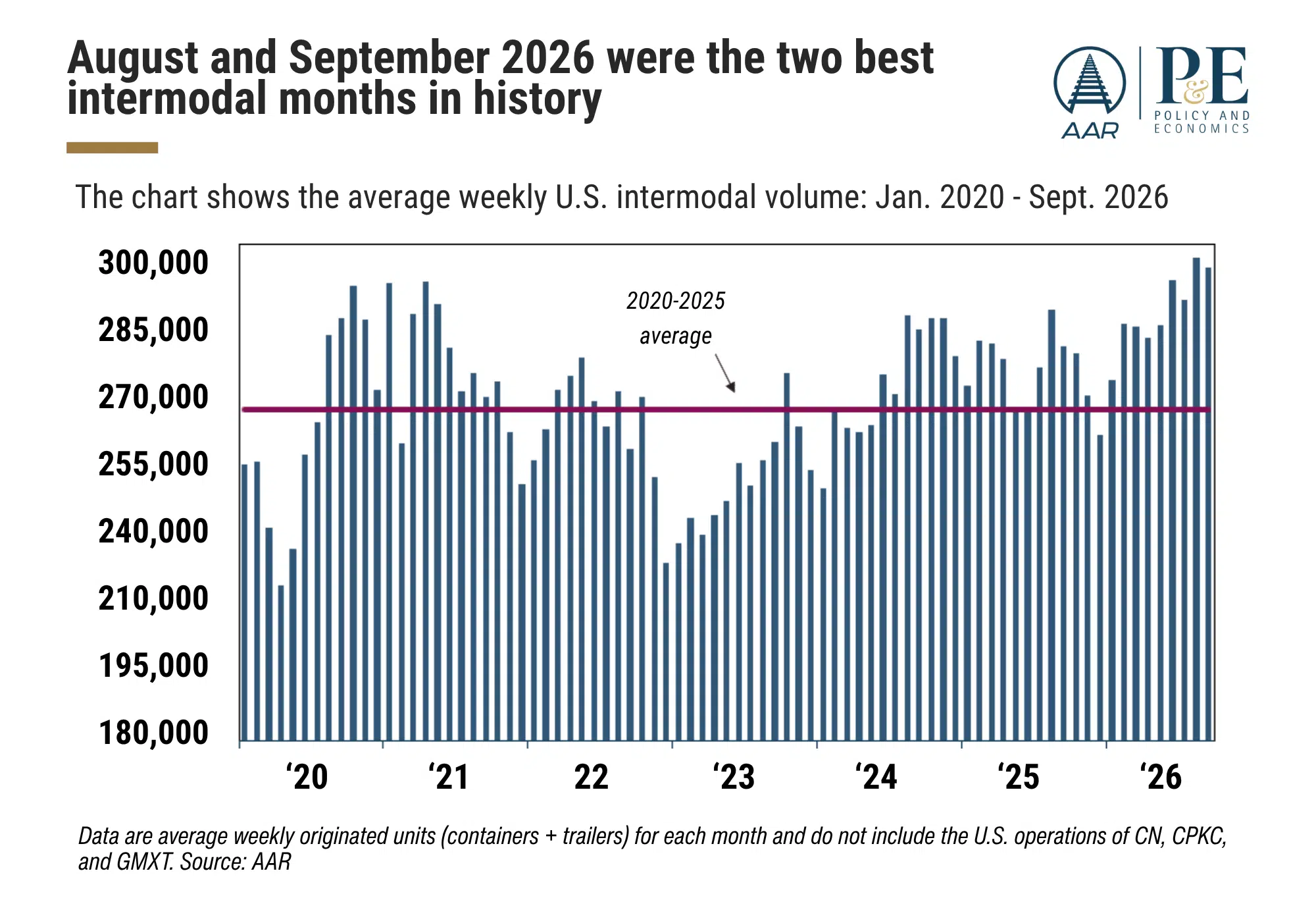
Rail traffic continues to perform well too. August, September, and the third quarter set new intermodal records, and total carloads have grown year over year for nine straight months. Excluding coal, carloads are growing twice as fast as the overall economy.
Importantly, carload growth is occurring across the industrial spectrum, not just in a handful of isolated sectors. The manufacturing expansion that took off at the start of the year appears increasingly durable. When coupled with resilient consumer demand, this bodes well for continued healthy rail volumes.
Best-ever intermodal volumes.
U.S. railroads originated nearly 295,000 intermodal containers and trailers per week in September, down only slightly from August’s record high despite the Labor Day holiday. This made the third quarter the highest-volume quarter ever for U.S. intermodal. Record-high diesel prices, an exodus of truck drivers driven by both market and regulatory factors, and generally strong railroad service levels have made intermodal an increasingly attractive option for shippers.
It helps that consumers continue to spend. The most recent inflation-adjusted consumer spending figures, for August, show overall spending up 2.6% over last year and spending on goods up 2.7%. Robust consumer spending keeps goods moving through supply chains, providing a critical source of support for freight volumes.
Continued broad carload growth.
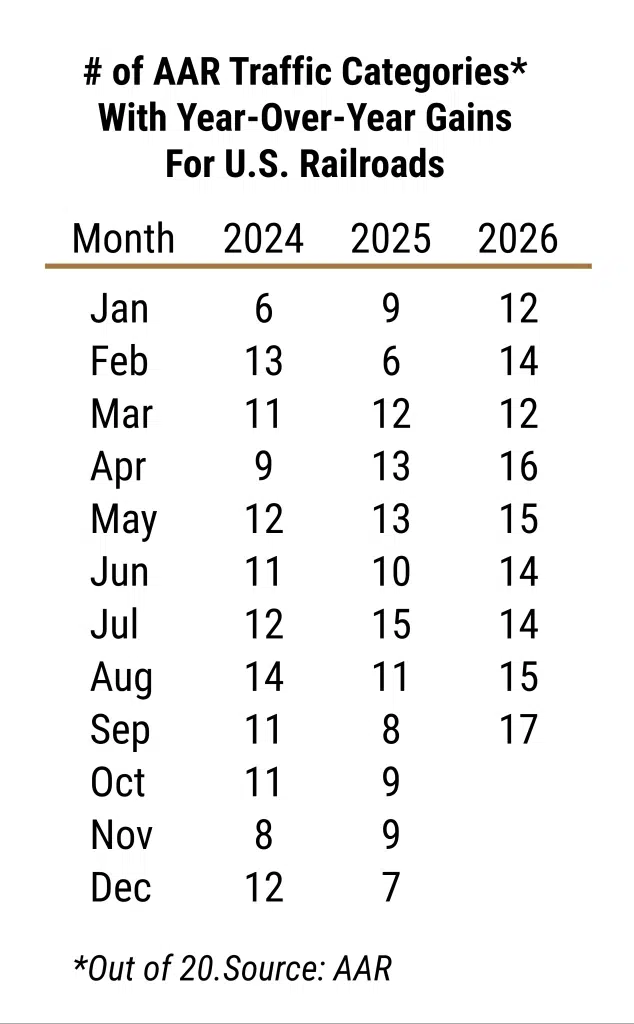
The AAR monitors 20 carload categories that collectively reflect all major freight-producing industries. In September, 17 of the 20 had year-over-year carload gains, the most in five years. That breadth matters because it points to widespread industrial momentum.
Steel had the largest absolute carload growth in September. In recent months, U.S. steel output has been the highest since 2012. Rail carloads of steel products in August and September were the most in five years. Steel is a key input for a wide range of industries, including autos, machinery, construction, energy, and appliances, and it’s a prime example of a critical industry with a symbiotic relationship with railroads.
Rail carloads of grain rose in September for the 18th time in the past 19 months. In the third quarter of 2026, grain carloads averaged around 22,000 per week, down from around 24,600 per week in the first quarter. U.S. grain exports have dipped in recent months from early in the year. Railroads play a crucial role connecting petroleum producers, processors, and consumers.
Rail carloads of petroleum products, which include LPG, crude oil, asphalt, distillate and residual fuel oil, and many other products, rose 11% year-over-year in September (their 9th straight year-over-year gain) and in absolute terms were the most for a month since early 2020.

Carloads of chemicals rose in September for the eighth time in the past nine months. They averaged nearly 33,200 per week in September, which is a September record. Chemical carloads are on pace to set a new annual record this year. U.S. chemical output is being spurred by manufacturing growth and by low natural gas prices relative to elsewhere in the world.
Year-over-year carloads of coal fell in September for the seventh straight month. Coal carloads are less than half what they were 20 years ago, but coal still accounts for a quarter of non-intermodal U.S. rail traffic. The same low natural gas prices that are spurring higher chemical output also make electricity generated from natural gas more competitive vis-à-vis electricity generated from coal.
Excluding coal, carloads in September grew 4.4% over last year, significantly faster than GDP growth.
The AAR Freight Rail Index (FRI) strips out coal and grain and seasonally adjusts the remaining traffic to create a timely gauge of economically sensitive rail volumes. In September, the FRI reached its second-highest level ever and its average for the third quarter of 2026 was a record high, pointing to continued strength across the goods-producing economy.
The number of freight cars in storage fell again in September and now equals 17.7% of the North American railcar fleet — the lowest share for railcars in storage since April 2023. A decline in stored cars suggests rising demand for freight rail services.
The economy continues to shrug off economic headwinds.
It’s not hard to find reasons for concern about the economy. Inflation is high enough that the Federal Reserve recently felt the need to raise interest rates for the first time in three years. Turmoil in the bond market is pushing other interest rates higher too, including mortgage rates, which recently topped 7% for the first time in several years. Consumer confidence is weak, diesel prices are setting records, and the global geopolitical environment is unusually virulent. The labor market appears stuck in a no-fire but also no-hire mode.
Despite all this, the economy continues to grow. U.S. GDP grew 2.2% in Q2 2026 over Q1 2026, and growth in Q3 is widely expected to be at least that strong.
Manufacturing expansion is one reason. The Manufacturing PMI® from the Institute for Supply Management® continued its strong run: September was its ninth straight month above 50%, signifying manufacturing expansion. Meanwhile, overall U.S. manufacturing output the past few months has been the highest since early 2022.
The Services PMI® is well into expansion mode as well and has been trending higher over the past year. Services account for around 80% of U.S. GDP and don’t generate rail volumes at anywhere near the same intensity as manufacturing or mining, but a healthy services sector supports consumer spending, business investment, and the broader economic activity that ultimately drives freight demand. Consumer spending remains robust, driving economic growth.
It’s always important to remember that things can change quickly, especially when there are a variety of potential flashpoints. That said, right now the freight economy appears to be on the right track.