Key Facts
- AI helps freight railroads prevent problems before they happen.
- AI enables predictive maintenance to keep trains running reliably.
- AI improves safety, efficiency, and fuel performance across the rail network.
🎧 Listen to this page narrated by a real person • 3 min 54 sec • Find the full transcript at the bottom of this page.
Artificial intelligence is the latest chapter in freight rail’s long history of using technology to make operations safer, more efficient, and more reliable. While today’s AI-powered inspection systems, predictive maintenance tools, and advanced analytics may seem new, railroads have been using forms of artificial intelligence and data-driven decision-making for decades.
Beginning in the 1950s, as computers emerged and artificial intelligence became a formal field of study, railroads were among the industries exploring how computing could improve scheduling, traffic management, and operational planning. Over the following decades, increasingly sophisticated computer models optimized train dispatching, crew scheduling, and railcar routing. By the 1980s and 1990s, railroads were using expert systems to support locomotive maintenance, pattern recognition to improve operations, and predictive analytics to identify potential issues before they became failures.
Today, AI is integrated into many of the tools and technologies rail employees use every day. By analyzing large volumes of real-time and historical data, AI-enabled systems help detect equipment and infrastructure issues early, support predictive maintenance, optimize fuel efficiency, enhance inspection processes, and improve network performance. These technologies help railroads identify potential problems before they cause disruptions, strengthening safety, reliability, and the efficient movement of goods across the United States.
The examples below highlight some of the ways freight railroads are using artificial intelligence today to support safety, maintenance, and network performance.
How do railroads use AI to detect wheel problems?
Trackside sensors capture large amounts of data as trains pass by, including wheel profiles, wheel impact loads, bearing acoustics, and component temperatures. AI learns the early signs of equipment problems and flags potential issues before they lead to failures, helping railroads address risks proactively.
For example, BNSF uses AI algorithms to analyze more than 35 million readings from wayside detectors each day, allowing the railroad to predict maintenance needs and reduce service disruptions. Norfolk Southern’s Wheel Integrity System combines AI and high-speed imaging to identify cracks and defects in train wheels before they become visible to the human eye, helping prevent failures and derailments.
Similarly, CPKC’s Optical AEI technology uses optical imaging, AI, and thermal sensing to monitor railcars and train components in real time, improving equipment identification and defect detection.
How do railroads use AI for predictive maintenance?
Onboard sensors continuously stream locomotive and performance data to centralized operations teams. AI compares this real-time information with historical maintenance and failure records to identify potential issues before they cause breakdowns. This predictive approach helps railroads schedule maintenance more effectively, improve reliability, and keep trains operating safely while reducing delays across the network.
How do railroads use AI and drones for inspections?
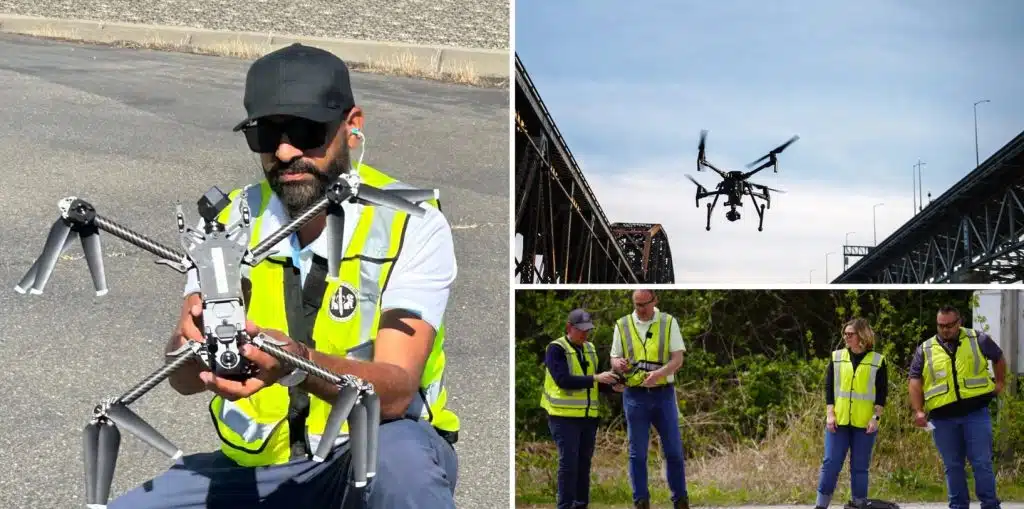
AI helps railroads inspect infrastructure more safely and efficiently by analyzing imagery collected by drones. These systems can identify bridge cracks, erosion, standing water, storm damage, and other conditions that may require attention.
Union Pacific has more than 250 certified drone operators who use drones, data analytics, and AI to inspect bridges, track, and other infrastructure. By combining aerial imagery with predictive analytics, the railroad can identify issues earlier, strengthen maintenance planning, and respond more effectively to changing conditions across its network.
How does AI help inspect trains?
AI-powered inspection systems use high-definition cameras and machine vision technology to inspect railcars and trains while they remain in service. These systems learn to recognize damaged wheels, components, and other defects, automatically flagging issues for further inspection.
For example, Canadian National operates digital train inspection portals that capture panoramic, high-resolution images of trains moving at track speed. AI analyzes equipment condition in real time, helping identify defects earlier, improve safety, and reduce operational disruptions while minimizing the need for manual inspections.
How do railroads use AI to monitor their networks?
Artificial intelligence is also helping railroads build digital representations of their networks. By combining data from onboard imaging systems, IoT sensors, and infrastructure inspections, railroads can create real-time digital twins that support monitoring, planning, and decision-making.
Take for instance Norfolk Southern, which uses AI and sensor data to maintain a real-time digital twin of its railroad network, enabling remote monitoring and earlier detection of potential infrastructure issues. Combined with predictive analytics, these models can simulate freight flows and yard operations, helping anticipate bottlenecks, improve scheduling, and strengthen network reliability.
How does AI make trains more fuel efficient?
Locomotive engineers use onboard energy management systems that incorporate AI to recommend more efficient throttle and braking strategies based on terrain, train makeup, and speed. These systems help improve fuel efficiency and reduce emissions while maintaining safe operations.
Railroads are also applying AI beyond train operations. CSX uses AI and edge computing to support real-time decision-making across its network, improving safety, reliability, and efficiency. By processing data closer to where it is generated, edge computing enables faster detection of issues and more responsive operational decisions.
Read the AAR Audio Narration
How Freight Railroads Use Artificial Intelligence
This is AAR Audio, and you’re listening to How Freight Railroads Use Artificial Intelligence.
Artificial intelligence may be one of today’s biggest technology stories. But for freight railroads, it’s part of a much longer story.
For decades, railroads have used increasingly advanced computers and data to make operations safer, more efficient, and more reliable.
As computers emerged in the 1950s, railroads were among the first industries exploring how technology could improve scheduling, traffic management, and operational planning.
Over the following decades, computer models helped optimize train dispatching, crew scheduling, railcar routing, and locomotive maintenance.
By the 1990s, railroads were already using predictive analytics to identify potential problems before they became failures.
Today’s artificial intelligence is the next step in that evolution.
One of AI’s biggest jobs is inspecting trains.
As trains move across the country, hundreds of onboard sensors monitor the engine, brakes, traction motors, wheels, and fuel use.
Engineers see that information in real time inside the locomotive cab.
Operations centers receive it too, allowing equipment to be monitored throughout the trip.
The train keeps moving.
The inspection never stops.
As trains travel the network, they also pass thousands of trackside sensors.
These sensors measure the condition of wheels and other critical components.
They look for changes in wheel shape.
They monitor heat.
They listen for unusual sounds that could signal a developing problem.
Many trains also pass through digital train inspection portals.
These systems use high-definition cameras and machine vision to inspect railcars while they’re moving at track speed.
Artificial intelligence brings all of that information together.
It learns what healthy equipment looks like.
Then it alerts employees when something begins to change.
Instead of waiting for equipment to fail, maintenance teams can often identify and repair problems while the train remains in service.
Artificial intelligence also gives railroads a broader view of the entire network.
It starts in places people can’t easily reach.
Drones inspect bridges, track, and other infrastructure.
They capture thousands of detailed images.
Artificial intelligence reviews those images for cracks, erosion, storm damage, standing water, and other conditions that may require attention.
That helps employees inspect infrastructure more safely while focusing their time where it’s needed most.
Some railroads take that a step further.
They combine information from drones, sensors, inspections, and locomotives to create real-time digital models of the railroad.
These digital twins help anticipate bottlenecks, improve scheduling, strengthen network reliability, and respond more quickly as conditions change.
Artificial intelligence also helps locomotive engineers operate more efficiently.
Onboard energy management systems recommend the most efficient throttle and braking strategies based on the train’s weight, the terrain ahead, and current operating conditions.
Artificial intelligence isn’t replacing skilled railroad employees.
It’s giving them better information.
It helps them find problems sooner.
It helps them find problems sooner.
It helps them plan maintenance more effectively.
The result is safer operations.
It also means greater reliability.
And a stronger supply chain.
For freight railroads, artificial intelligence isn’t a technology of the future.
It’s another tool that helps skilled railroad employees keep America moving every day.
THE BOTTOM LINE
Freight railroads use artificial intelligence to identify problems before they happen, predict maintenance needs, and optimize operations in real time, making the network safer and more efficient. By combining AI with sensors, data analytics, and human expertise, railroads reduce risks, prevent delays, and keep goods moving reliably across the U.S. supply chain.