
Helpful Links
- AAR Data Center
- States
- How Railroading Works
- Railroad 101
- Railroad Chronology
- Harley Explains Video Series
Facts & Figures
Below are helpful data points and quick information about the freight rail industry. You can download all these facts and figures in a single fact sheet. Last updated September 2025.
Safety
- Freight railroads are the safest way to move goods over land, and the last decade was the safest ever for U.S. railroads.
- The train accident rate down 43% since 2005 and 11% since 2023.
- The Class I railroad derailment rate is down 40% since 2005.
- Class I railroads’ mainline accident rate is down 43% since 2005.
- Year-over-year human error and equipment-caused accident rates both improved, decreasing 28% and 36% respectively since 2005.
- The equipment-caused accident rate is down 37% between 2005 and 2024.
- The track-caused accident rate is down 56% between 2005 and 2024.
- Class I railroads decreased yard accident rate per million-yard switching miles by 32%, reversing last year’s increase.
Hazmat Safety
- More than 99.99% of all hazmat moved by rail reaches its destination without a release caused by a train accident.
- Per carload, the hazmat accident rate is at its lowest ever and down 80% since 2005.
Employee Safety
- The freight rail industry is one of the safest places to work in America.
- For all railroads, on-duty fatalities declined 27% since 2005; 2024 was the third lowest on record.
- Railroads have reduced employee casualty rates by 27% since 2005 and 4% since 2015. Last year was the third lowest on record.
Grade Crossing Safety
- In 2024, grade crossing collision rates declined slightly year over year and were down 25% compared to 2000.
- Since 2005, the total number of public crossings has declined 12%, while the number with gates has increased 42%.
Investments
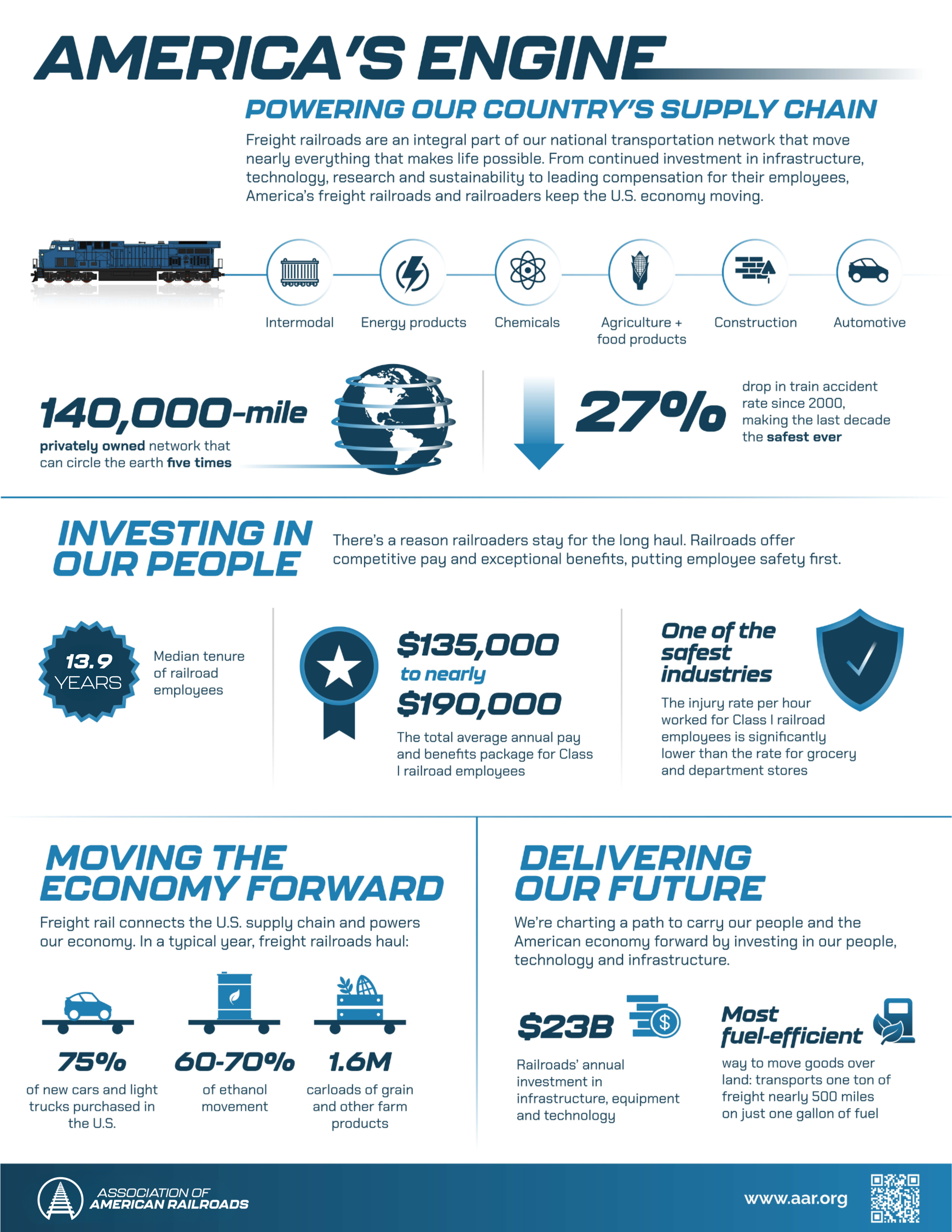
- Freight railroads privately invest more than $23 billion annually.
- From 1980 through 2024, U.S. freight railroads reinvested approximately $840 billion—close to $1.4 trillion in today’s dollars—of their own funds, not taxpayer funds, on capital expenditures and maintenance expenses related to locomotives, freight cars, tracks, bridges, tunnels and other infrastructure and equipment. It is $1 billion more than the historic investments Congress has made in 2021 in rail and multi-modal programs in the IIJA and the omnibus combined.
- The average U.S. manufacturer historically spends about 3% of revenue on capital expenditures. The comparable figure for U.S. freight railroads between 2014 and 2023 averaged more than 18% or six times higher.
Economic Impact
- Rail is a major driver of economic activity, generating $233.4 billion in total economic output in 2023.
- In 2023, Class I railroads reinvested $26.8 billion in modernizing infrastructure, enhancing safety and improving reliability.
- Every $1 invested in rail transportation drives $2.50 in economic activity.
Decarbonization
- Freight railroads account for roughly 40% of U.S. long-distance freight volume (measured by ton-miles)—more than any other mode of transportation. However, they account for just 0.5% of total U.S. greenhouse gas emissions, according to EPA data, and just 1.8% of transportation-related greenhouse gas emissions.
- Railroads are the most fuel-efficient way to move freight over land, moving one ton of freight nearly 500 miles per gallon of fuel, on average.
- On average, railroads are three to four times more fuel-efficient than trucks.
- A single freight train can replace several hundred trucks.
- Greenhouse gas emissions are directly related to fuel consumption. That means moving freight by rail instead of truck lowers greenhouse gas emissions by up to 75%, on average.
- If 10% of the freight shipped by the largest trucks were moved by rail instead, greenhouse gas emissions would fall by nearly 20 million tons annually. That’s the equivalent of removing 4.3 million cars from our highways or planting 300 million trees.
- Today’s fuel-efficient locomotives have emitted fewer criteria pollutants and GHGs over the past decade. Idling-reduction technology, such as stop-start systems, can reduce unnecessary idle time by 50%.
- Advanced software improves fuel efficiency by up to 14% by calculating the most efficient speed, spacing and timing of trains.
- In 2023 alone, U.S. freight railroads consumed 709 million fewer gallons of fuel and emitted 7.9 million fewer tons of carbon dioxide than they would have if their fuel efficiency had remained constant since 2000.
- If railroads did not move freight in the United States, it would take more than 80 million additional trucks traveling on public roadways and would take up to four times more fuel than rail to handle the freight Americans rely on every day.
Jobs
- The industry directly employs 153,000 workers, but its total employment impact is far greater—supporting 749,000 jobs nationwide through supply chains and consumer spending.
- Every railroad job creates 3.9 additional jobs in industries like manufacturing, logistics and technology.
- About one in six rail employees are veterans.
- The median tenure of railroad employees is 13.8 years (compared to 3.9 years for other private sector workers).
- The average Class I railroad employee’s annual pay and benefit package is valued from $135,000 to almost $190,000.
- Career railroaders (those 60+ who have served at least 30 years) receive more than two times as much retirement income as the average Social Security recipient.
- Class I rail carriers and several of their union partners have already reached — and in many cases, ratified and implemented—more than 50 local and national collective bargaining agreements to resolve the 2025 bargaining round.
Capacity & Demand
- The freight rail network is nearly 140,000 miles.
- There are six Class I railroads and approximately 615 short line railroads (Class II and III).
- Class I railroads account for around 67% of freight rail mileage, 87% of employees and 94% of revenue.
- Freight rail accounts for around 40% of long-distance ton-miles—more than any other mode of transportation.
- Freight rail is part of an integrated network of trains, trucks and barges that ships around 59 tons of goods per American every year.
- In a typical year, freight railroads haul around 1.5 billion tons of raw materials and finished goods.
- Redesigned railcars have helped increase average tonnage. In 2023, the average freight train carried 3,948 tons, up from 2,923 tons in 2000.
- The Federal Highway Administration forecasts that total U.S. freight movements will rise about 30% by 2040.
Chicago
- For 150 years, Chicago has remained the nation’s busiest rail hub.
- All six U.S. Class I railroads operate there, as do many non-Class I railroads.
- Approximately one in four rail carloads and intermodal units originate, terminate or pass through the Chicago area.
Amtrak
- Amtrak owns 623 route miles (primarily in the Northeast) and operates, maintains, and dispatches another 229 route miles in Michigan and New York.
- The vast majority of the remaining 96% of Amtrak’s more than 21,400-mile system consists of tracks owned and maintained by freight railroads.
- Around 70% of the miles traveled by Amtrak trains are on freight-owned tracks.
Rates
- Average rail rates (measured by inflation-adjusted revenue per ton-mile) were 44% lower in 2024 than in 1981. This means the average rail shipper can move much more freight for the same price it paid more than 40 years ago.
Agricultural & Food Products
- In a typical year, railroads haul around 1.6 million carloads of grain and other farm products, more than 1.7 million carloads of food products, and several hundred thousand carloads of fertilizers and the raw materials that go into making them.
- Railroads typically carry more than 60,000 carloads of food and agriculture products per week.
- One railcar can carry enough: Flour for about 258,000 loaves of bread, or Corn for the lifetime feeding of 37,000 chickens or Barley for about 94,000 gallons of beer or Soybeans for about 400,000 pounds of tofu.
Coal
- Freight railroads moved 3.4 million carloads of coal in 2022.
- While rail coal volumes have declined in recent years, railroads account for around 70% of U.S. coal deliveries to power plants.
- One rail car can carry enough coal to power 20 homes for a year.
Construction & Pulp/Paper
- Freight railroads move more than two million carloads of construction-related materials in a typical year.
- One rail car to carry as much crushed stone, sand and gravel as five trucks.
- The U.S. pulp and paper industry is one of the largest industries in the world. In a typical year, America’s freight railroads carry around 700,000 carloads of pulp and paper products.
Crude Oil
- In 2023, the average carload of crude oil originated in the United States carried around 650 barrels of oil. Based on that, the 97,000 carloads of crude oil originated by U.S. Class I railroads in 2023 was equivalent to around 173,000 barrels per day, or approximately 1.3% of U.S. production.
- One rail carries enough crude oil to make approximately 13,500 gallons of gasoline.
Intermodal
- In 2023, U.S. rail intermodal volume was 12.7 million units, and intermodal accounted for approximately 25% of revenue for major U.S. railroads, more than any other single rail traffic segment.
- Intermodal has been the fastest-growing major rail traffic segment over the past 25 years.
- Around half of rail intermodal volume consists of imports or exports, reflecting the vital role intermodal plays in international trade.
Motor Vehicles & Parts
- In 2024, automakers sold about 15.85 million light vehicles, including cars and light trucks, marking a 2.2% increase over 2023, an achievement made possible in large part by freight railroads.
- Freight railroads are part of every production stage of an automobile—from moving raw materials and auto parts to delivering a finished car or truck to dealerships across the nation.
- In a typical year, U.S. Class I railroads carry 1.8 million carloads of motor vehicles and parts.
- With a single train capable of carrying hundreds of cars, freight rail transports around 75% of the new cars and light trucks purchased in the U.S.
Chemicals
- Chemicals help clean our water, fertilize our farms, package our food, build our cars and homes, protect our health, and enhance our well-being in thousands of other ways.
- Freight railroads moved 2.3 million carloads of plastics, fertilizers and other chemicals in 2022.
- One rail tank car of anhydrous ammonia carries the equivalent of around four tanker trucks and enough to fertilize 770 acres of corn.
Grain
- The United States is the world’s largest grain producer.
- Railroads account for well over a third of U.S. grain export movements, according to the USDA.
- In 2022, U.S. Class I railroads moved 1.5 million carloads of grain.
- Corn is by far the highest-volume grain carried by railroads.
- As of early 2023, the North American railroad grain car fleet consisted of around 273,000 cars (owned by railroads and non-railroads) with a 1.4 billion cubic feet capacity.
PDF Fact Sheets
Safety & Technology
- Safety Overview
- Bridges
- Employee Safety
- First Responders
- Grade Crossing Safety
- Hazmat Remediation
- Hazmat Safety
- Inspections
- MxV Rail
- Physical & Cybersecurity
- Positive Train Control (PTC)
- Railinc
- Railroad Police
- Remote Control Locomotives
- Safety Record
- Strategic Research Initiatives (SRI) Program
- Technology
- Tank Car Committee (TCC)
Railroad 101
- Railroad 101
- Amtrak
- Chronology
- Climate & Network Resiliency
- Collective Bargaining
- CREATE
- Decarbonization
- Differential Pricing
- Economic Impact
- How Freight Rail Operations Work
- How Freight Trains Move
- Investments
- Military & Veterans
- Jobs
- Revenue Adequacy
- The Staggers Act of 1980
- States
- Supply Chain
- Time Off Policies
What We Haul
- Customers Overview
- Automotives
- Chemicals
- Construction, Paper & Pulp
- Energy: Crude Oil, Ethanol & Coal
- Food & Agriculture
- Intermodal
Issues
- Policy Overview
- Automated Track Inspections
- ATI Waiver Request
- Blocked Crossings
- CARB EPA
- Cargo Theft
- CORCA
- Crew Interchange
- Cyber Legislative Priorities
- Decarbonization Policies
- Economic Regulation
- Environmental Permitting
- FSP Grant Requirements
- Hazmat & Tank Car Regulations
- Highway Trust Fund
- International Interchange
- Modern Regulatory Framework
- Passenger Policies
- Reconciliation Tax
- Right of Way Access
- Surface Reauthorization
- Trade
- Train Length
- Truck Size & Weight
Reports
- Supply Chain Resilience: Shows that freight rail acts as a built-in stabilizer in the U.S. economy. Amid rising transportation costs and supply chain stress, rail’s efficiency, predictability, and resilience help buffer inflation and volatility.
- Economic Impact Report: Quantifies rail transportation’s economic impact, finding that in 2023, railroads contributed $233.4 billion in total economic output.
- Jobs Report: Explores the benefits and opportunities of railroading and get insights straight from employees.
- Rail Industry Overview (RIO): Free monthly publication that provides insights from our economists into what rail traffic says about today’s economy and where the data suggests it could be headed.
Industry Partners
- The American Short Line & Regional Railroad Association: Represents about 600 owners and operators of short line and regional railroads throughout North America.
- GoRail: Works with thousands of community leaders across the country to tell the local story of freight rail — stronger economies, more jobs and cleaner skies.
- League of Railway Women (LRIW): Professional association that advances the representation, recognition, and opportunities for women in the railroad industry.
- MxV Rail: Wholly-owned subsidiary of the AAR and the railroad industry’s world-class rail research and testing facility that works to improve the safety and efficiency of freight railroads throughout North America and the world.
- Operation Lifesaver, Inc.: Nonprofit public safety education and awareness organization dedicated to increasing driver and pedestrian safety at grade crossings.
- Railinc: Wholly-owned subsidiary of the AAR and the leading provider of IT, related network operations and financial services and near rail-time network data to North America’s railroads.
Infographics



AAR Government Affairs
Freight rail operates under rigorous regulations overseen by the Surface Transportation Board (STB), an independent federal adjudicatory board. Additionally, the Federal Railroad Administration (FRA), a branch of the U.S. Department of Transportation, enforces safety standards. It’s imperative for railroads to implement effective policies to sustain their investments in personnel, infrastructure, equipment, and technology, thus ensuring safe, efficient operations vital to modern American life and global competitiveness.
- Adrian Arnakis, SVP (202-639-2539) aarnakis@aar.org
- Melissa Connolly, AVP (202-639-2533) mconnolly@aar.org
- Holt Edwards, AVP (202-639-2538) hedwards@aar.org
- John Glaser, Manager (202-639-2527) jglaser@aar.org
- Devon Lidz, Congressional Affairs & PAC Manager (202-639-2535) dlidz@aar.org