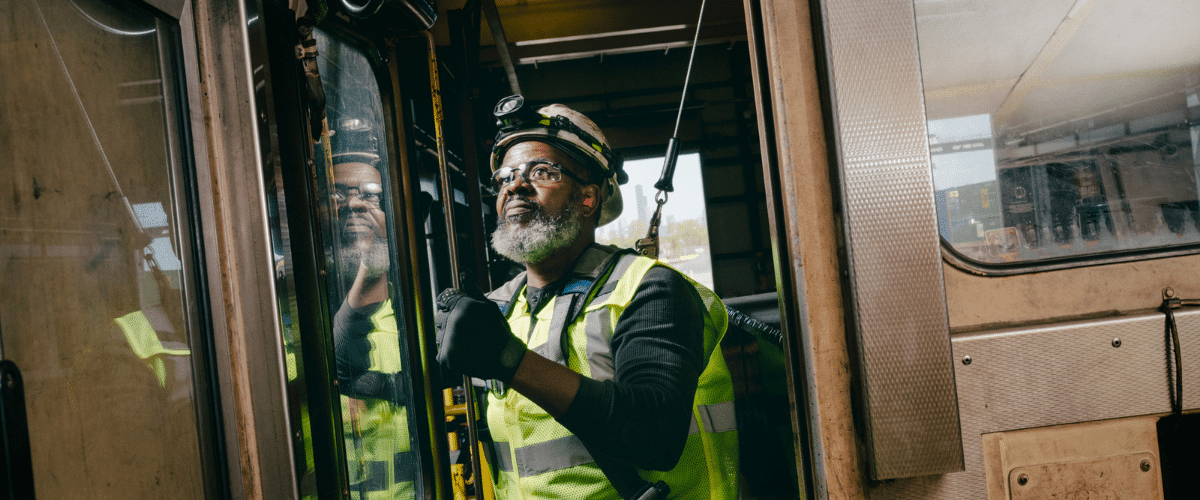
Safety is a never-ending process that is an integral part of rail operations. Empowered by technology and data insights, railroaders are dedicated to keeping the rail network safe throughout the train safety journey from the beginning to its end and beyond.
Safety first starts in person. At a train’s origin, mechanical employees and train crews thoroughly examine the train to ensure critical components meet rigorous industry safety standards. Train dispatchers at rail operations centers keep engineers and crews informed of route conditions. This ensures smooth and safe travel throughout the train safety journey. Advanced technology, including AI and machine learning, transforms real-time data into actionable insights. This enhances decision-making. By analyzing data across the 140,000-mile network, railroads can prioritize proactive maintenance. This improves safety, efficiency, and reliability.
Machine visioning gives railroads x-ray sight.
Machine visioning stations capture hundreds of images per second of locomotives and railcars that pass through at-speed. They capture potential issues human eyes may miss. The technology helps railroads look at many elements all at once. This provides a comprehensive view of locomotives, trains, and their components on their safety journey.
Virtual worlds prepare train crews for reality.
New railroad employees train extensively before handling locomotives or railcars. Using simulators and virtual modules, they gain hands-on experience in a controlled setting. This enhances safety and efficiency. The locomotives they operate in the real world have sensors throughout. These sensors continually gather data on the performance of individual components during the train safety journey.
Positive Train Control supports locomotive engineers.
Positive Train Control (PTC) enhances safety for locomotive engineers by automatically preventing train collisions, derailments, and speed violations. This allows them to operate with greater confidence and precision. Similar to other virtual training, new engineers virtually experience how the PTC system initiates. It constantly assesses variables, ensuring the train has time and space to stop safely along the route when necessary during the train safety journey.
Lasers keep big wheels turning.
Smart track-side sensors, using infrared, lasers, and acoustic technology, monitor the health of wheels and bearings across the rail network. Hotbox detectors measure bearing temperatures to prevent overheating and potential derailments. Track-embedded lasers capture over 1,000 images per train to profile each wheel on its safety journey. Additionally, advanced computers analyze train sounds to detect axle bearing issues before they require repair.
Automated track inspections turn insights into action.
Track-side infrared, laser, and acoustic sensors transmit data to centralized systems. This allows railroads to monitor locomotive and car health. They perform repairs before safety limits are reached. Track geometry cars and onboard sensors assess rail-wear, track alignment, curve elevation, and gauge. This identifies anomalies in real time. By quickly addressing issues, railroads prevent minor problems from escalating. Thus, ensuring safer and more efficient operations.
Drones help keep railroaders out of harms way.
Railroads enhance safety by using drones to inspect hard-to-reach sections of bridges and tracks. This reduces risks for employees and ensures infrastructure integrity. They also utilize sonar technology to assess bridge pier stability, especially after storms or flooding. Similar to whale echolocation, sonar sends sound waves that bounce off bridge piers and the riverbed. This helps railroads detect erosion that could compromise structural integrity. This method is particularly valuable in murky waters, where human divers would struggle to evaluate conditions effectively.