
FREIGHT RAIL KEY FACTS
- About 74% of derailments happen in low-speed rail yards,
- The Class I railroad derailment rate is down 40% since 2005.
- Minor events like misaligned couplers must be reported as derailments under federal rules.
Freight railroads are dedicated to safeguarding the communities they serve, their employees, and the products they ship. That’s why they privately invest an average of $23 billion each year in safety technologies, employee training, and infrastructure and equipment maintenance and improvements. Thanks in large part to these investments, the derailment rate for Class I railroads has dropped 40% since 2005.
The vast majority of train derailments happen in rail yards.
The average train speed in a freight rail yard is about five MPH. The vast majority of freight train derailments happen in rail yards, not on mainline track running across the country. With rail yard derailments, injuries are rare, property damage is minimal, and the impact on the local community is little to none.
According to Federal Railroad Administration (FRA) data, for all of 2024, there were 793 Class I railroad train derailments. About 74% occurred in rail yards and 26% on the mainline tracks. Of that 26%, five derailments resulted in four injuries (non-fatal), while six resulted in a hazmat release.
As the safest way to move freight over land, freight railroads are committed to driving down train derailments, especially on the mainline. With that goal in mind, railroads take a strategic approach to where they make network investments. For example, track and equipment failures are two of the leading causes of mainline derailments.
Freight rail’s consistent investments in network maintenance and capital expenditures and deployment of advanced inspection technologies have helped. They identify wheel and track issues before they become problems. These efforts have helped drive down the equipment-caused accident rate by 37% and the track-caused accident rate by 56% between 2005 and 2024.
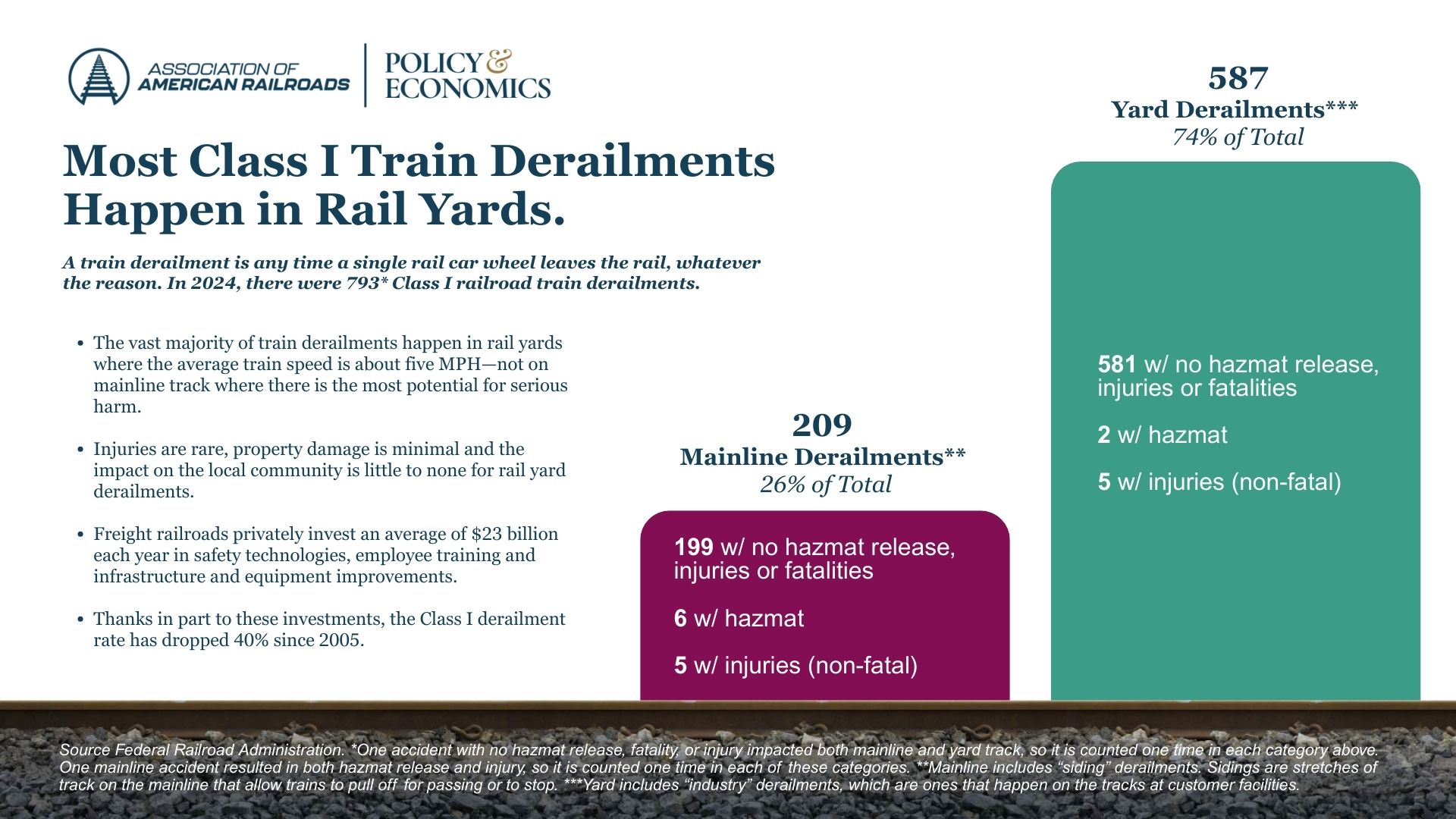
Any time even a single rail car wheel leaves the rail, whatever the reason, railroads are legally required to report that data to the FRA as a derailment.
Any time there is a single occurrence of $12,400 in damage to rail track or equipment, the derailment must be reported as an accident. Two typical examples of derailments in rail yards that result in little or minor damage include shoving movement derailments and passed couplers.
A rail switch is a mechanism installed in the track that guides a train from one track to another. A shoving movement is when a locomotive is pushing a group of cars during a switching operation. During the movement, the lead car could inadvertently go past the intended stopping point and run through a switch and damage it. Alternatively, it could pass through the switch and strike another railcar. This event would be logged as a derailment.
Each rail car has a coupler on either end, which allows it to connect to another car. If the couplers are misaligned when trying to connect the rail cars, rather than coupling, they could pass each other. The resulting lateral force could be enough for a wheel to go off the track. This would also be logged as a derailment.