KEY FACTS
- Railroads pioneered one of North America’s first real-time communication networks.
- Today, railroads conduct over 3.5 million automated inspections daily.
- Advanced sensors, AI and data analytics continue improving freight rail safety and reliability.
Freight railroads have long been at the forefront of technological innovation. Centuries before our modern digital age, railroads pioneered real-time communications, large-scale logistics coordination, and early data systems to safely manage complex networks spanning thousands of miles.
From telegraph lines in the 1800s to punched-card computing in the early 20th century, railroads built the foundation for modern networked operations. Today, that same spirit of innovation powers advanced inspection portals, machine vision systems, predictive analytics, and automated safety technologies.
Thanks in part to freight rail’s ongoing use of technology, since 2023, the train accident rate is down 11%. Between 2020 and 2023 alone, U.S. railroads more than doubled the number of daily automated inspections, which use advanced trackside detectors to identify equipment and track defects invisible to the naked eye*. And today, railroads conduct over 3.5 million of these automated inspections daily.
1800s: Rail Builds America’s First Real-Time Network

👆 View of railroad tracks and telegraph wires near a train depot in Colorado, 1880-1890. Denver Public Library Special Collections, Z-4016.
Before digital computers and wireless networks, railroads invented what was, in its time, one of the world’s first real-time operational networks. Telegraph wires were installed alongside tracks, carrying constant updates on train locations, delays, cargo, and operational instructions. Dispatchers used these signals to coordinate train movements across thousands of miles — not as a convenience, but as a safety necessity.
This communication web evolved into detailed tracking of arrivals, loads, fuel, maintenance needs and revenue, turning railroads into one of the earliest large-scale data ecosystems long before computers existed.
Late 1800s–Early 1900s: Early Computing and Standardization
👆 Check out how the punched-card tabulating machine worked.
Railroads didn’t just build tracks — they shaped how data was used in business. By the 1890s, freight railroads were among the first enterprises to adopt proto-computing technologies, such as punched-card tabulating machines, to process complex logistics data.
As technology advanced, railroads worked with early computing developers to build systems that could track railcars and manage operations at scale — helping demonstrate to the broader business world that computing could solve real, large-scale problems.
Early 1900s: Scaling the Nation’s Connected Economy

👆 Railroad Engine 633 pulling into a small town train station. Photograph, ca. 1900s. Missouri History Museum Photographs and Prints Collections. Transportation. N29827.
Railroads didn’t just transport goods — they linked economic activity across the country. In the mid-1800s and into the early 1900s, rail lines transformed isolated towns into nodes of national commerce, connecting producers, consumers and industries and creating a shared infrastructure that enabled growth far beyond regional boundaries.
This connectivity was foundational for later operational technologies — it wasn’t just physical infrastructure, it was the first network of coordinated data flow in the U.S. — decades before digital systems emerged
Mid-20th Century: Mainframe Computing Modernizes Rail Operations
👆 Discover the IBM 7070 mainframe, a groundbreaking fully transistorized computer from 1960, showcased in this rarely seen restored film from the Computer History Archives Project.
By the mid-20th century, freight railroads were turning to large-scale mainframe computers (the kind that took up entire rooms) to manage the growing complexity of their networks. As freight volumes increased and operations expanded across thousands of miles, railroads adopted early commercial computing systems to track railcars, manage shipments and coordinate logistics more efficiently.
These mainframe systems allowed railroads to process vast amounts of operational data — improving visibility across the network and enhancing decision-making long before personal computers or digital platforms existed. The integration of computing into rail operations marked a significant shift from manual recordkeeping to data-driven management, laying critical groundwork for the fully computerized dispatch and tracking systems that would emerge decades later.
Early 1990s: The Computerization of Freight Rail Operations

☝Union Pacific Harriman Dispatch Center in the early 1990s. Photo Credit: Gateway NMRA.
The early 1990s marked an accelerated shift in technology adoption as freight railroads increasingly used computerized management systems. These systems revolutionized operations and logistics, streamlining processes that were once manual and time-consuming. Improved radio communication and Computer Aided Dispatcher systems significantly enhanced operational efficiency and safety.
Cab signaling systems began using electronic signal transmission from track circuits to the train’s onboard equipment, giving train operators more timely and precise information about upcoming signals and track conditions. And Radio Frequency Identification (RFID) technology, which uses electromagnetic fields to automatically identify and monitor tags attached to objects, was widely adopted for better tracking of freight and rail assets, offering real-time visibility and improved inventory management.
Late 1990s: The Expansion of Automated Rail Systems and Real-Time Monitoring
👆 These late-1990s advances marked an early shift toward automated condition monitoring — helping lay the foundation for today’s autonomous track assessment technologies, like CSX’s automated track assessment cars.
Ultrasound detectors emerged to identify flaws deep inside rails, enhancing the safety and reliability of rail infrastructure. Wayside detectors became more sophisticated as the first generation of data analytics and machine learning grew, enabling railroads to prioritize preventative maintenance.
The late 1990s saw freight railroads adding more wayside detectors that automatically monitored railcars and their wheels as they passed by at speed. These included truck geometry detectors, truck performance detectors, wheel profile detectors and wheel impact load detectors. This period also marked an improvement in freight tracking through Electronic Data Interchange (EDI) systems and remote monitoring systems that tracked locomotives and railcars in real-time.
In July 1999, the Transportation Technology Center, Inc. (TTCI, now MxV Rail), a subsidiary of AAR, conducted a system evaluation test to evaluate improved wayside acoustic bearing detection systems, with TTCI providing the prototype and other suppliers collecting data. While not commercially available during this time, in the years to come, acoustic bearing detectors will become capable of detecting bearings that may be reaching the end of their service lives by monitoring and assessing noise and vibrations.
Early 2000s: Intelligent Inspection and Advanced Train Control Take Shape
☝ Example of a Norfolk Southern machine visioning portal, which uses advanced imaging and AI technology to take hundreds of thousands of high-res images per second of trains passing through at speed.
In the early 2000s, freight railroads began testing machine vision systems that could inspect trains at speed, significantly reducing inspection times and improving accuracy by providing a consistent, ongoing inspection. Compared to today’s modern, digital systems, these versions relied on analog cameras, basic optical sensors and limited processing power. Ground penetrating radar started assessing sub-surface conditions of the track bed, helping to identify issues like ballast degradation and subgrade problems, while hot bearing detectors gained wider use.
Virtual reality simulators were introduced to enhance training programs for train operators, providing a safe and immersive learning environment. Automated Single Car Test Devices demonstrated the ability for technology to pinpoint anomalies far better than manual test devices. Improvements to the Automated Single Car Test Devices have been ongoing, and the Association of American Railroads (AAR) has a schedule for requiring the latest in automated technology.
The beginning of the 2000s also saw enhanced locomotive technologies, including improved radio systems between distributed power locomotives and the End of Train Device to improve train brake communication throughout the train. A distributed power locomotive, also known as a Distributed Power Unit (DPU), is a locomotive that can be placed in the middle or at the end of a train to help it haul more and climb steep hills, improving train handling. An End of Train Devices, or EOT, is mounted on the rear of a freight train and provides essential information to the locomotive crew and trackside systems, including brake monitoring.
Mid-2000s: The Emergence of Positive Train Control and Networked Rail Safety
👆 Union Pacific helps explain how PTC works.
In the mid-2000s, Positive Train Control (PTC) emerged as a pivotal safety technology in the rail industry. Designed to automatically stop a train to prevent accidents, PTC was developed to mitigate human errors such as speeding and running red signals. The technology is highly advanced, relying on real-time data communication between trains, trackside equipment and centralized control systems; GIS integration for tracking train locations; and data analytics to process huge amounts of information from multiple sources.
In 2006, Railinc’s Equipment Health Monitoring System (EHMS) began gathering comprehensive equipment data, helping to inform preventative maintenance. In the years to come, hot bearing detector information will become part of EHMS. It was also during this time that the integration of satellite communication systems enabled real-time tracking and monitoring of trains, significantly enhancing the management and responsiveness to operational challenges. Distributed power use also increased, improving train handling.
2010–2015: The Rise of Big Data Analytics, Drone Inspection, and LiDAR in Freight Rail
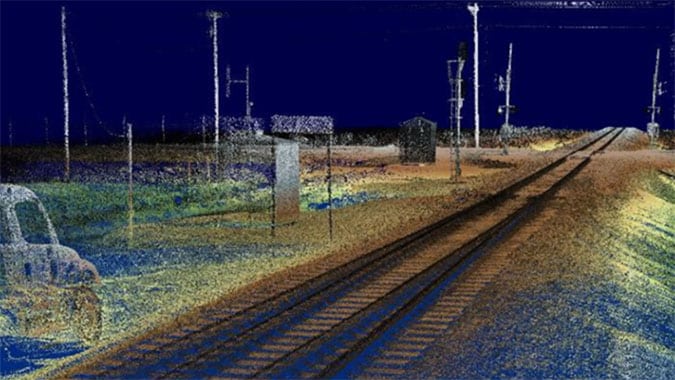
👆 A detailed view of BNSF track using LiDAR technology.
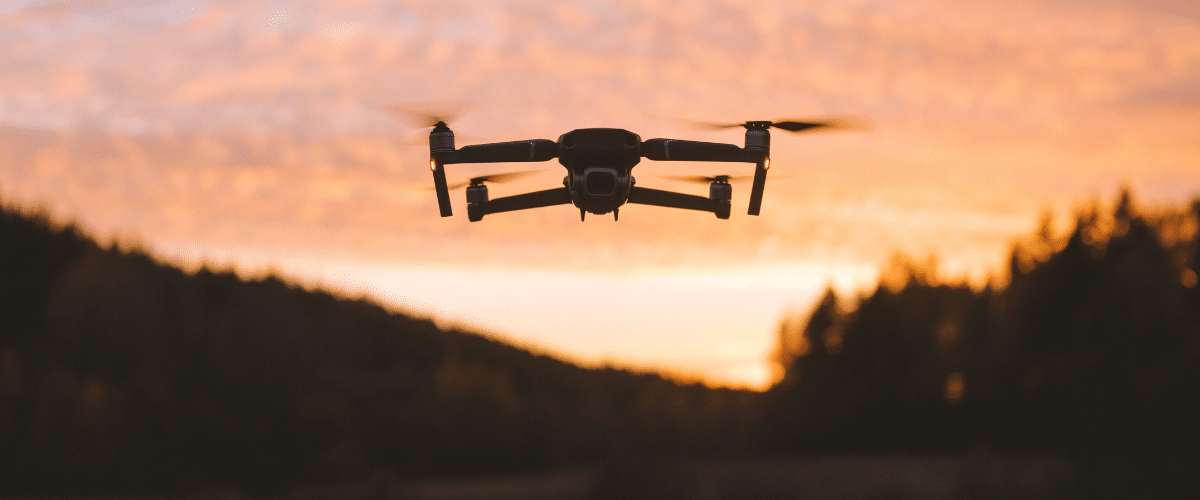
This period saw a surge in advanced data analytics and increased automation. Drones take flight, revolutionizing track inspection and maintenance by accessing hard-to-reach areas such as bridges. This not only enhances infrastructure safety but also protects employees. Light Detection and Ranging (LIDAR) technology began creating precise 3D models of the track environment, helping to find track geometry issues and other structural problems.
2015–Present: Interoperability, AI and the Connected Rail Network
👆 Norfolk Southern uses uses various technologies to create a real-time digital twin of its rail network—detecting issues early, improving safety and optimizing freight operations.
Since 2015, the freight rail industry has undergone a technological revolution driven by rapid advancements in data analytics, Internet of Things (IoT) integration and predictive maintenance systems. As these technologies have allowed for more efficient data processing, storage and sharing, railroads have fine-tuned their existing technologies while developing and implementing more advanced solutions, including through Artificial Intelligence. It was also during this time that PTC became interoperable, meaning different railroad systems could seamlessly communicate and operate together using the technology.
The Future of Freight Rail: MxV Rail and Railinc Driving Innovation
☝ The 2.8-mile FAST loop can be used to conduct tests with trains traveling up to 40 mph.
MxV Rail, an AAR subsidiary in Pueblo, Colorado, is at the forefront of developing and testing many of these safety technologies. Recently moving its multi-campus operations, the team completed a new loop track for the renowned Facility for Accelerated Service Testing (FAST®). This state-of-the-art facility is at the forefront of rail research, gathering essential data for over 30 annual experiments. Supported by the Strategic Research Initiative (SRI), MxV Rail drives innovation across infrastructure, mechanical and operations systems in the rail industry from inception to deployment.
Railinc, also a subsidiary of AAR, collects extensive data to help North America’s freight railroads make their operations even safer. Launched by the Class Is and railcar owners, the Asset Health Strategic Initiative (AHSI) is a multi-year, multi-phase effort that the AAR Safety and Operations Management Committee oversees with Railinc. The project uses a wide range of technologies to provide the health of rolling stock to all stakeholders, particularly to the railroads on which the cars and locomotives are operating. These insights help inform railroads’ proactive maintenance plans.
* Railroads do not report 100% of their automated railcar inspection events to Railinc; therefore, these numbers may be an underestimate of the overall data collection process. Along with the increased number of automated inspections, the computer algorithms used to detect equipment failures have also improved since 2020, improving the efficiency to predict failures. About 800,000 railcars (half of the fleet) move on any given day i.e. not in yards, loading/unloading, storage or being repaired.