
TRUCK SIZE & WEIGHT KEY FACTS
- Congress shouldn’t raise TSW limits without fully assessing safety and infrastructure impacts.
- Heavier trucks underpay for road damage, shifting costs to taxpayers and hurting rail.
- Rail reduces emissions and congestion—bigger trucks risk undoing those benefits.
Congress limits trucks on the Interstate to 80,000 pounds and two 28-foot trailers. Some groups want to raise the weight limit to 91,000 pounds—a 14% increase. Alternatively, they propose letting governors waive federal size and weight rules. These proposals have repeatedly failed because heavier, longer trucks are bad policy.
Congress should not approve any changes until the DOT completes the Highway Cost Allocation Study required by the Infrastructure Investment and Jobs Act. The study will show how vehicle weight impacts road damage. With the Highway Trust Fund already relying on taxpayer transfers, increasing truck size and weight would only add more strain.
Infrastructure Damage
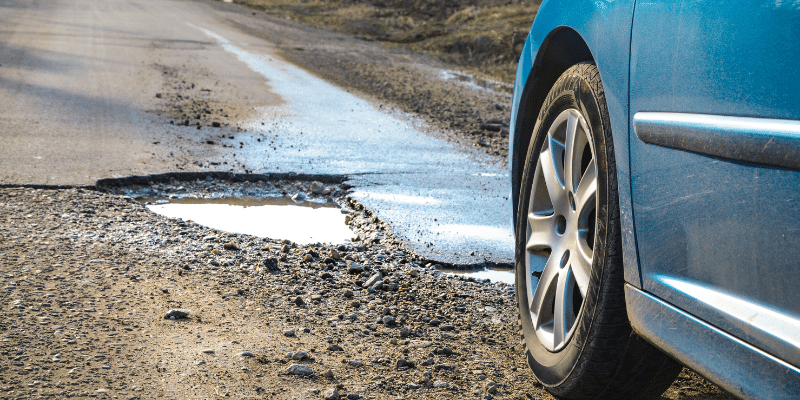
Raising truck size and weight (TSW) limits would add more large trucks to highways. This would accelerate pavement deterioration and drive up lifecycle costs. A study using decades of pricing and demand data found that higher TSW limits would cause unaffordable highway wear. It would also divert freight from rail to trucks.
The American Society of Civil Engineers reports that about half of U.S. bridges are structurally deficient or over 50 years old. DOT estimates that 91,000-pound trucks would impact over 4,800 bridges. Meanwhile, Twin 33s could cause $1.1 billion in immediate bridge damage. They could also cause $1.2–$1.8 billion in annual pavement damage.
Tax Burden
The current tax of 18.4 cents per gallon of gasoline and 24.4 cents per gallon of diesel fuel was last increased in 1993. It has failed to keep pace with highway maintenance costs and changing fuel prices. Additionally, more fuel-efficient vehicles are now on the road. Since 2008, policymakers have been forced to transfer a total of $275 billion of general taxpayer funds into the Highway Trust Fund (HTF) to cover this shortfall. This includes $118 billion in the 2021 Infrastructure Investment and Jobs Act (IIJA). However, this funding will only cover the HTF shortfall through 2026.
The Government Accountability Office found that HTF underpayments by the trucking industry distorts freight transportation competition. This distortion occurs “by making it appear that heavier trucks are…less expensive…than they actually are, and puts other modes, such as rail and maritime, at a disadvantage.”
Less Rail, More Traffic
Congress last increased the federal weight limit in 1982. Then, as now, those pushing for longer and heavier trucks said it would result in fewer trucks on the road. But that never happened. In fact, the number of trucks registered in the U.S. and the mileage of trucks traveled has increased.
- Raising truck weight limits from 80,000 to 91,000 pounds (with no change in trailer length) could divert an estimated 2.6 million rail carloads and 1.8 million intermodal units annually.
- Increasing allowable truck weight from 80,000 pounds to 97,000 pounds could reduce merchandise traffic on Class I railroads by up to 50% and overall Class I rail traffic by up to 19%.
- Increasing truck weight to 120,000 pounds, combined with twin 33-foot trailers, would divert 7.5 million annual rail carloads and 8.5 million intermodal shipments. The diversion of this traffic would represent an even more significant burden on taxpayers.
Negative Environmental Impact
Freight railroads offer a sustainable, efficient way to move cargo across the country on infrastructure. Railroads have spent well over $23 billion a year on average to maintain and improve this infrastructure. While freight rail accounts for 40% of long-distance freight ton-miles, it only accounts for 1.8% of U.S. transportation-related emissions.
Moving freight by rail instead of truck lowers greenhouse gas emissions by up to 75%, on average. AAR analysis of federal data finds: If 25% of the truck traffic moving at least 750 miles went by rail instead, annual greenhouse gas emissions would fall by approximately 13.6 million tons. If 50% of the truck traffic moving at least 750 miles went by rail instead, greenhouse gas emissions would fall by approximately 27.2 million tons.
More Research Needed
Congressionally-directed research would help show the extent of the impacts of different truck configurations on driver safety. Additionally, it should address the service life and deterioration rates of bridges, pavement condition, and the potential impacts of such changes on long-term solvency of the HTF. In a 2016 study, DOT noted the difficulties encountered in studying the effects of the size or weight of various truck configurations. Therefore, they requested that the Transportation Research Board (TRB) develop a program of research to overcome limitations in data analysis and modeling of impacts.
Completion of this research could better inform DOT’s highway cost allocation study, pursuant to the Infrastructure Investment and Jobs Act (section 11530 of P.L. 117-58). This cost allocation study will provide an essential baseline for the direct costs of highway use by various types of users, including commercial motor vehicles.
In 2018, TRB released its TSW Research Plan, which outlined 27 research projects. The completion of these projects would contribute to the improved evaluation of potential changes to TSW limitations. In its FY20 and FY21 omnibus appropriations bills (P.L. 116-94; P.L. 116-260), Congress directed DOT to expeditiously develop an implementation plan. This included projected timelines for conducting the research. They also noted that the research should be completed before any changes in federal TSW policy are considered.
DOT has not submitted the implementation plan. This plan would ensure the research is completed on time and within budget. The study will review costs for safety, emissions, congestion, and noise. It will determine each highway user’s share of those costs and compare them to the fees they pay into the Highway Trust Fund. DOT will then recommend revenue options to cover these costs.