FREIGHT RAIL SAFETY INSPECTIONS
- Highly-trained employees and technology spot issues early.
- Automated systems monitor equipment in real time.
- Freight rail’s $23B+ annual investments help lower accident rates.
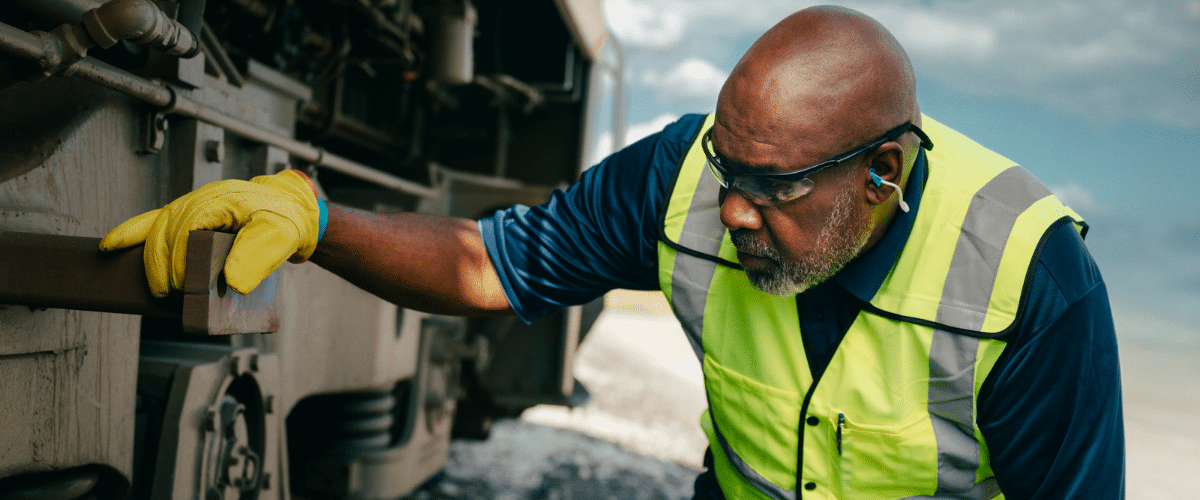
Railroads employ thousands of well-trained inspectors qualified under FRA regulations. They monitor equipment moving essential goods and nearly 140,000 miles of track. Employees inspecting or performing federally regulated tasks must meet prescribed training standards. This includes inspecting signals, tracks, railcars, locomotives, and bridges. Beyond FRA-required inspections, railroads have long invested in advanced technology to supplement manual inspections.
Thousands of sensors across the rail network collect billions of data points daily, generating alerts for urgent issues. Advanced programs, machine learning, and AI analyze this data to identify patterns and predict repairs days or months ahead. These elements include tracks, wheels, bearings, locomotive components and more. This information helps give railroads lead time to proactively schedule maintenance and fix issues before they become dangerous.
Between 2020 and 2023 alone, U.S. railroads more than doubled the number of daily automated inspections. These inspections use advanced trackside detectors to identify equipment and track defects invisible to the naked eye*. Today, railroads conduct over 3.5 million of these automated inspections daily.
Freight Railroad Track Inspections
From 1980 to 2023, freight railroads invested $810 billion—over $23 billion annually in recent years—averaging $260,000 per mile. Inspections and maintenance make up a significant share of this spending.
All disciplines perform federally required inspections plus additional ones per each railroad’s maintenance rules. Beyond visual checks, regulations mandate internal rail, bridge, signal, crossing, and geometry inspections. Many railroads exceed these frequencies, using advanced technologies to speed inspections and improve quality.
For example, track geometry and ultrasonic track inspections help pinpoint defects usually not visible to the human eye. They can also only be identified when the track is in use. Moreover, they allow railroads to inspect more track in less time and provide data to schedule maintenance proactively.
ATI measures how track structure performs under a train’s weight.
Automated Track Inspection systems use lasers and cameras mounted onto locomotives or railcars to inspect track as a train travels across the network. The system tests each foot of track. This detects issues that may not be visible when a track is not occupied.
The data from the inspection devices transmits to a centralized location where employees verify and schedule maintenance as necessary. ATI speeds up safety inspections and safeguards employees.
Track inspection vehicles, or “track geometry cars,” can measure hundreds of thousands of track miles yearly. The cars travel along the tracks, measuring every inch for track alignment, elevation in curves, gauge (the distance between the two rails), and many other track geometry measurements. An advanced algorithm can analyze track alignment of more than 1,500 curves in track in just a few hours. In contrast, it would have taken a team of four people 10 months to complete the same task manually.
Ultrasound looks for flaws inside tracks and ties.
As a train travels over any track segment, energy is transmitted through the track and into the ground below. This energy can be measured as a series of sound waves by ultrasound, collectively called an acoustic signature. The acoustic signature of a track is different depending on the health of the track. Going further down, ground-penetrating radar looks inside track foundation—known as ballast—to see water damage or deterioration.
Drones inspect track, ballast and bridges.
Loose or missing fasteners in track or soft spots in ballast could cause more stress on the track structure and lead to signal problems. Railroads use drones most frequently after weather events to look for washouts, downed trees, misaligned track, and other conditions caused by weather. This technology provides trending data. Railroads can analyze older snapshots with newer ones.
Regular inspections of railroad bridges by inspectors or drones are vital for trains safely transporting goods across bodies of water. Sonar also identifies increased erosion around the piers, which can compromise a bridge’s integrity. Sonar sends sound waves that bounce off the bridge piers and the ground surface below the water. Then, based on the nature of the echo, railroads determine whether there are any concerns with the stability of the bridge piers.
Signal inspectors look at active grade crossings.
Railroad employees help ensure safety at the points where trains cross roads, known as grade crossings. Signal inspectors climb up on the lights to ensure they are pointed in the right direction. They open the bungalow, check everything in the case, and look at the timing and distance between the train coming into the crossing circuit and the crossing protection coming down.
Freight Train & Equipment Inspections
FRA regulations and AAR interchange standards establish stringent thresholds to ensure the health and safety of the more than 1.6 million railcars (and 12 million wheels) traveling across the country daily. Rail employees visually inspect each train before departure in accordance with those standards. If a car does not meet those standards, railroads make appropriate repairs to ensure safety.
The customer owns more than 99.9% of all tank cars. Entities other than railroads own more than 80% of all covered hopper cars, such as all cars that carry plastic pellets.
Some defects can only be identified when the asset moves, which only technology can accomplish through tools like infrared and laser systems in wayside detectors. These detectors assess moving locomotives and railcars, identifying defects that may only be apparent during operation. Consequently, by employing real-time dynamic assessment, they detect anomalies or potential issues early on. This improves safety and prevents performance problems or track damage.
These detectors assess moving locomotives and railcars, identifying defects that may only be apparent during operation. By employing real-time dynamic assessment, they detect anomalies or potential issues early on, improving safety and preventing performance problems or track damages.
The Asset Health Strategic Initiative, developed in the mid-2000s and led by AAR and its data management subsidiary, Railinc, maintains the “Equipment Health Management System (EHMS). Through the EHMS, Railinc collects and centralizes detector-generated data. This helps car owners and railroads see alerts and proactively repair equipment based on AAR or FRA rules. Here are just a few examples of the wayside detectors railroads use.
Locomotive sensors monitor individual components.
While a train is on the move, hundreds of sensors throughout the locomotive continually gather data on the performance of individual components. Sensors transmit the data to analysts using real-time software to identify equipment needing maintenance. Locomotives also have fuel management systems that use sensors that provide engineers with real-time recommendations on how to operate the train to maximize fuel efficiency. Sensors also sense when an engine is getting too hot or when oil is contaminated.
Machine visioning inspects passing trains.
Machine visioning technology uses cameras that collect 40,000 images per second of trains as they pass by at up to 60 MPH. This technology reduces inspection times to mere seconds. A series of algorithms then analyze the images to identify any anomalies, allowing railroads to resolve issues faster than they could with manual inspections alone. In sum, the technology helps railroads look at many elements simultaneously, providing a comprehensive view of locomotives, trains, and their components.
Lasers, scanners and more inspect moving wheels.
Additionally, hot bearing detectors are strategically placed along the right-of-way to sense overheating bearings, alerting engineers to stop a train when necessary. Some detectors transmit temperature data. This allows proactive tracking and replacement of bearings. Wheel impact load detectors greatly reduce broken rails and prevent wheel and bearing failures. They do so by identifying heavily pounding wheels so they can be removed from service.